What if a fab contract names our drivers?
Some Silicon Valley fab and lab contracts name the drivers allowed on site, so each of them should be on your auto policy's driver list, with a current MVR, before the first escorted visit.

Commercial auto for the contractors and service fleets that keep Santa Clara County's campuses, data centers and neighborhoods running, from Palo Alto to Gilroy.
Quick answer
Silicon Valley fleets are mostly service vans on campus and data center contracts, and those contracts often drive the policy: a $1 million combined single limit, additional insured and waiver wording, plus hired and non-owned coverage for engineers in their own cars. We take the contract language to national carriers, which decide whether to approve each endorsement, and list each van where it sleeps.
Commercial Auto + Fleet Insurance
CaliforniaUp to 50 VehiclesWe’re here to help.
Silicon Valley's roads were built for commuters, and service fleets fight the same peaks. US-101 runs along the bay from Palo Alto through Mountain View, Sunnyvale and Santa Clara to San Jose and on south to Morgan Hill and Gilroy; I-280 follows the foothills through Cupertino; and I-880 and I-680 carry traffic north toward the East Bay. SR-85, SR-87 and SR-237 fill in the gaps, and SR-17 climbs over the Santa Cruz Mountains to the coast.
What sets the valley apart is its county expressway system: Lawrence, Central, San Tomas, Montague, Capitol, Almaden, Foothill and Oregon-Page Mill, signal-controlled roads that technicians use to move between campuses when the freeways stall. Light rail crossings in San Jose and Mountain View and Caltrain grade crossings along the Peninsula line add their own hazards for a van in a hurry.
Campuses change how a service call works. Security gates, badge checks, loading docks with time slots and parking garages with low clearances are routine; a high-roof van or a ladder rack may not fit the garage, and a truck waiting at the gate is a truck not working. Data centers in Santa Clara and San Jose add escorted access and tight dock schedules.
Some technicians commute from as far as Tracy or Hollister, so a company van's garaging address may be in another county entirely. South of San Jose, Morgan Hill and Gilroy bring farm roads, summer heat and the SR-152 climb over Pacheco Pass toward Los Banos. The weather is otherwise mild, and the first rain of the season tends to bring a wave of fender-benders on US-101 and the expressways.
South county traffic runs on its own clock. Mornings on US-101 move north out of Gilroy and Morgan Hill toward San Jose, and a crew based in south county with a campus job in Sunnyvale can lose the first hour of the day to it. Through Coyote Valley the freeway opens up, traffic speeds climb, and mixing fast commuters with loaded service trucks there calls for patient drivers and a firm rule against phone use.
This page covers Santa Clara County, from Palo Alto and Mountain View to San Jose, Morgan Hill and Gilroy. The cities it names, with populations:
Official sources
Silicon Valley runs on service work. Data centers in Santa Clara and San Jose need electrical contractors' vans and service trucks and mechanical and HVAC crews for the power and cooling that never stop, and low-voltage, fire alarm and access control installers wire the offices and labs; alarm and security installers' vans have their own page. Directional boring crews pull fiber and power conduit along the streets between them.
Tech campuses keep facilities contractors busy year-round, and constant tenant turnover means buildouts, moves and reconfigurations. Engineering and consulting firms send staff to sites in their own cars, which is what engineering firms' field vehicle coverage and hired and non-owned coverage address. Residential remodels and accessory dwelling units across San Jose, Sunnyvale and Campbell keep plumbers, framers and painters working, and south county's farms and food processors around Gilroy bring repair and supply work.
Semiconductor fabs and research labs bring their own demands: escorted access, strict rules for vehicles on site and contracts that may name the drivers allowed to enter. Hospitals and the region's universities keep facilities contractors on long-term service agreements, and San Jose's older neighborhoods keep remodelers and plumbers moving along narrow, tree-lined streets where a trailer is more trouble than it's worth.
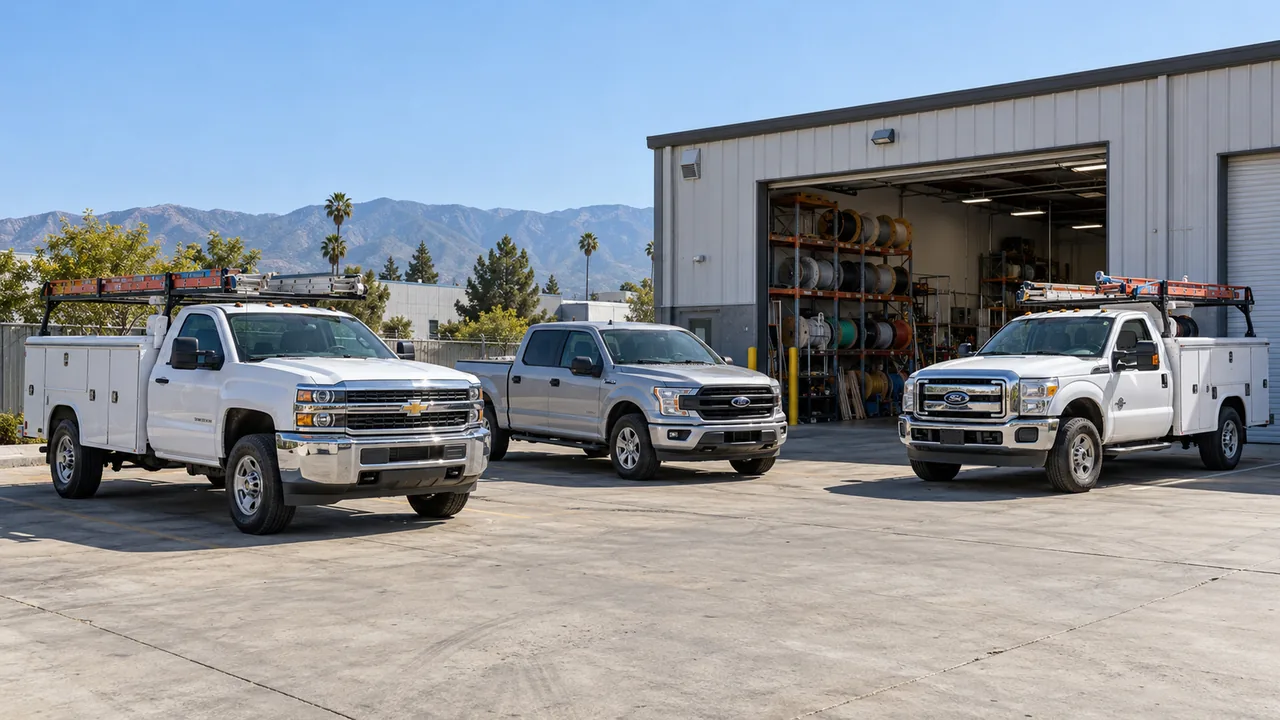
The typical fleet here is a set of upfitted Sprinter and Transit vans with a few service body trucks, almost all under 26,001 lbs. Campus and data center contracts usually ask for a $1 million combined single limit with additional insured, waiver of subrogation and primary wording, and some ask for more than $1 million, which is often met with an umbrella placed over the auto policy.
Growth tends to come in jumps here. A contractor wins a data center or campus contract and needs eight more vans in a month, often upfitted with shelving, ladder racks and inverters worth far more than the base vehicle. Add each van by endorsement before it goes to work, and schedule the upfit value along with it. When a contract ends and vans come off the road, tell us, so they don't ride on the schedule until renewal. For permits and filings by weight, see the California truck requirements guide.
Gilroy is our South Bay dump truck page. South county's subdivisions, ag land and road work keep single-axle dumps busy between Gilroy, Morgan Hill and San Martin, and the page covers that local hauling. The statewide picture is on our California dump truck page.
Disputed collisions are a real local risk. In a 2026 case, the California Department of Insurance reported that a San Jose driver was convicted of insurance fraud after brake-checking a semi-truck on US-101 and claiming he'd been rear-ended; in the department's words, “The entire road rage incident was captured on the semi-truck's dashcam.” How staged collisions target commercial vehicles explains why a forward camera is worth having on a van fleet too.
Earthquake is the region's other planning question: A large Bay Area quake could damage vans in parking structures and close freeways and bridges for days, and earthquake planning for Silicon Valley fleets explains what physical damage generally pays by cause of loss. Day to day, the more common loss is a break-in at a van parked overnight on a residential street, where the broken window can be an auto claim, but the tools inside usually are not.
Official sources
Some Silicon Valley fab and lab contracts name the drivers allowed on site, so each of them should be on your auto policy's driver list, with a current MVR, before the first escorted visit.
When a new Santa Clara data center contract brings a rush of Sprinter and Transit vans, the shelving, ladder racks and inverters sometimes go unscheduled, even though that upfit can be worth more than the van it's bolted into.
Silicon Valley fleets grow and shrink with campus contracts, and vans idled when a contract ends tend to ride the schedule until renewal; reporting them as they come off the road helps keep the policy matched to the fleet.
When a Silicon Valley technician drives a company van home to Tracy or Hollister, its garaging address, and the rating tied to it, moves to another county, and the long commute generally counts as business use the underwriter will ask about.
Timing depends on the carriers and your loss history.
Have ready: vehicle list with VINs, driver list, current declarations page, loss runs.
This page covers fleets garaged anywhere in the region. These are the 41 cities and 90 ZIP codes within 25 miles of San Jose. Cities with their own page here are linked.
Next Level Experience. Insurance Done Right.
Fleet quotes for California businesses running up to 50 trucks and vans.