Work pickupGVWR
- Weight
- Up to 14,000 lbs typical
- CDL
- No
- Trades
- Every trade

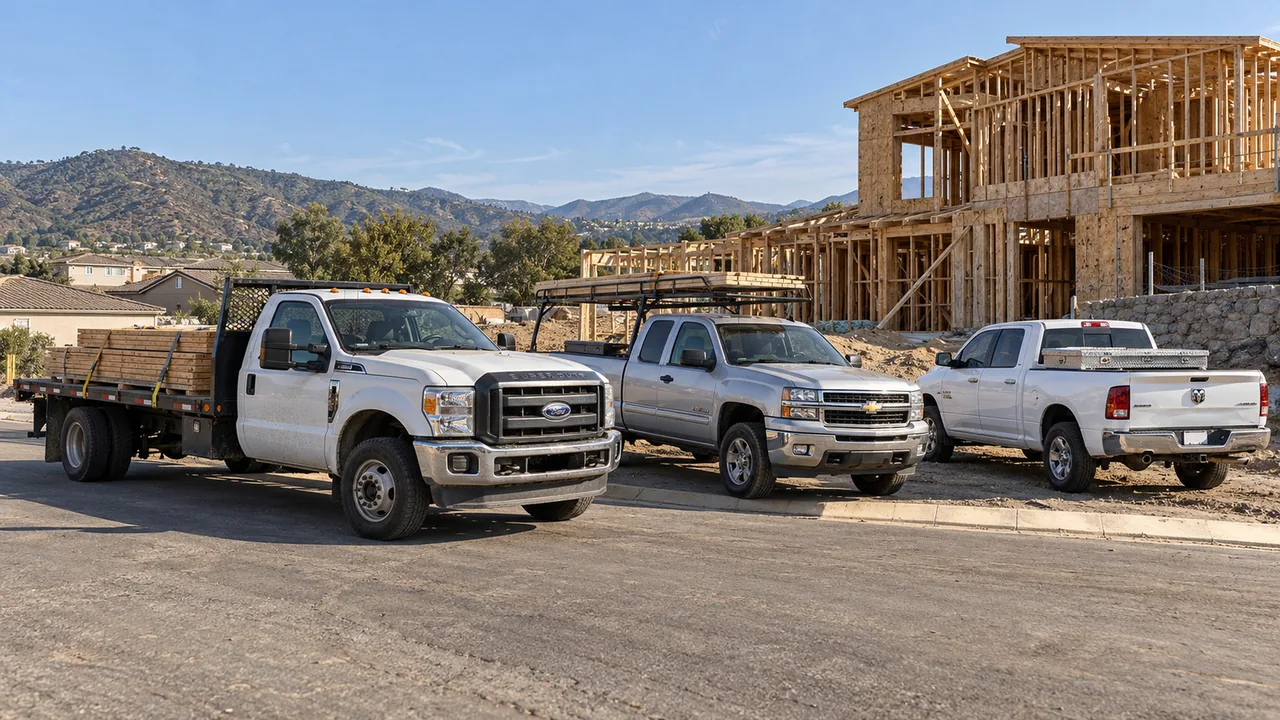
Commercial auto for framing contractors whose flatbeds and stake beds move lumber, sheathing and beams between lots and whose crews ride to the tract in crew-cab pickups. From a single truck to up to 50 vehicles.
Quick answer
A framing contractor's auto policy should list every crew truck, flatbed, stake bed and trailer, name everyone who drives them and carry the auto limit in your builder contracts, usually a $1 million combined single limit. Wrap-up programs on big jobs usually leave auto out, and the telehandler on your trailer generally needs an equipment policy.
Commercial Auto + Fleet Insurance
CaliforniaUp to 50 VehiclesWe’re here to help.
Framing runs on lumber, and lumber moves on flatbeds. The lumberyard drops the main package, but framers spend their days moving what's left: a partial lift of studs to the next lot, LVL beams and posts, hangers and hardware, sheathing for the second floor and the stack of cut-offs that has to go somewhere. Stake beds with removable sides do most of that work, along with one-ton flatbeds and the gooseneck trailer that carries the telehandler between phases of a subdivision. When the yard's delivery truck can't reach a lot, crews break the package down and shuttle it themselves, which is when the stake bed earns its keep and when overloads tend to happen. The work itself has a state definition: CSLB's C-5 Framing and Rough Carpentry classification covers form work and framing along with sub-flooring, siding, roof decking, truss members and sheathing.
Crews ride, too. A typical tract framing crew shows up in two or three crew-cab pickups, five people to a truck, with nail guns, compressors, cords and saws in the beds. On custom homes and podium multifamily, the crew truck may stay at one site for months, parked on a half-built street with no curbs, lights or striping yet.
Most framing pickups and stake beds sit below 26,001 lbs GVWR, so crews can usually drive them on an ordinary license. A larger flatbed, or a heavy trailer behind a one-ton, can cross into commercial license territory; check the door-jamb rating before the truck goes to a new driver. Flatbed and stake bed truck insurance goes deeper on how those bodies are rated.
Official sources
A framer's worst auto claims tend to start with the load: a strap that loosens on the way out of the yard, a bundle of joists that slides when the driver brakes for a light, a sheet of OSB that sails off a stake bed at freeway speed. Whatever the load damages on the road is typically an auto liability claim, and most builders write a $1 million combined single limit into framing contracts as the minimum. Liability coverage for work trucks explains how that limit is applied.
Physical damage is meant to protect the flatbeds and crew trucks themselves. Site roads are hard on vehicles: rutted dirt, rebar stubs, steep pads and morning frost in the foothills. Rollovers with a top-heavy load and low-speed collisions in crowded subdivision streets often show up on framing loss runs alongside highway crashes, so collision coverage on newer units is usually worth carrying.
Crew leads who drive their own pickups to the job on company time create a non-owned exposure. Non-owned auto coverage is designed to protect your company when one of those trucks is in a crash on your business.
Production builders and multifamily general contractors usually require a $1 million combined single limit on a framing sub's auto policy, with the builder named as additional insured and a waiver of subrogation in its favor. Smaller custom builders sometimes accept $750,000 or $500,000, and a framer working mainly on remodels may get by with $300,000, but the subcontract usually decides, not the size of your truck.
Large projects add a wrinkle. Many podium and mid-rise jobs run an owner- or contractor-controlled insurance program, a wrap-up, that generally covers general liability and workers' comp for the trades on site. Those programs usually leave auto out, so your own auto policy is still expected to meet the contract limit. Builders typically want to see it on a certificate before your crews mobilize.
Production builders often manage certificates through a vendor compliance portal that checks the wording for them. A certificate missing the additional insured endorsement, or one that shows last year's dates, can freeze your pay applications until it's fixed, so send us the portal's requirements along with the trade contract.
A framing yard whose trucks stay under the commercial license line rarely deals with filings. Before a heavier flatbed starts hauling, read when a Motor Carrier Permit is required.
Framers who can show written load-securement steps and a rule that only screened drivers move the flatbeds tend to stand out. Fleet safety measures underwriters often credit explains why cameras and simple written rules can carry weight when a claim is disputed. Early starts on unlit tract streets are a fair question, too; a rule that trucks are loaded and strapped in daylight the afternoon before answers it well. A short list of approved drivers for each flatbed, kept steady from year to year, is easy to show and easy to defend.
A framer starting out with one crew-cab pickup and a utility trailer for the compressor and gun boxes is usually quoted much like any one-truck contractor. The owner's record and the garaging ZIP carry most of the rating, and the carrier will likely ask how many people ride in that truck on a typical morning.
Five to ten units usually means two or three crews, each with a crew truck, plus a stake bed and a gooseneck for the telehandler. That's when carriers tend to ask for a driver policy in writing and want to know who moves the flatbed between lots. Fleet insurance for five to ten trucks covers how that account is rated. If the telehandler comes from a rental company, read the rental contract too; it may make you responsible for the machine while it rides on your trailer.
Production framers with eleven to fifty units run crews across several subdivisions at once, often in different counties, from a yard full of stake beds and flatbeds. Underwriters tend to focus on how new hires are screened before they drive, how trucks are assigned and the trend in your loss runs over three to five years. When a builder awards you a new phase and you add trucks, send them to us before the first load so coverage can be in place when the work starts.
Load securement is where a framing company can do the most to keep its auto losses down. Lumber is heavy, slick when wet and rarely the same shape twice. A partial bundle shifts more easily than a banded package, and a stake bed loaded above its sides has nothing holding the top layer but the straps.
The habits underwriters like to hear about are plain ones: strap every layer, not just the top; put a strap near each end of long stock; keep a headache rack between the load and the cab; flag anything that hangs past the tailgate; and recheck straps after the first few miles, when a load settles. Past a certain point the flag is also a rule of the road: Caltrans' overhang guidance calls for a solid red or fluorescent orange flag by day and two red lights after dark on stock projecting four feet or more beyond the rear. Sheathing and roof panels catch wind, so they ride flat and tied, never leaning against the stakes. Long engineered beams are their own case: When one is longer than the deck, plan the move with the right trailer instead of improvising with an extra strap.
Write those steps down and show them to every driver who moves material. If a sheet of plywood ever does come off on a freeway, a documented routine and a camera showing the load at departure can make the claim easier to defend. Commercial auto for contractors covers the policy side; the straps are up to you.
Official sources
Injuries to your own employees usually fall under workers' comp, not auto liability. Passengers who aren't your employees are typically an auto question.
A short hop between lots on a public street is still driving. Anyone who moves a truck should be on your driver list and screened like everyone else.
Framing crews often hit the road before dawn, onto unfinished streets with no lights or curbs. Underwriters like hearing how you handle that first hour: who drives and how loads are checked.
Typically, the gooseneck and the truck pulling it are auto, and the telehandler riding on them is equipment. Without an equipment policy, a rollover can leave the most expensive item uninsured.
The next trade in, with stake beds and booms.
Commercial auto for drywall contractorsBox trucks with liftgates and padded loads.
Commercial auto for cabinet makersVans heavy with tile, plank and carpet rolls.
Commercial auto for flooring installersVans carrying ladders, paint and sprayers.
Commercial auto for painting contractorsSupers' pickups, equipment trailers and small dumps.
Commercial auto for general contractorsTiming depends on the carriers and your loss history.
Have ready: vehicle list with VINs, driver list, current declarations page, loss runs.
Next Level Experience. Insurance Done Right.
Fleet quotes for California businesses running up to 50 trucks and vans.