TrailerGVWR
- Weight
- Rated with the towing unit
- CDL
- Depends on combination
- Trades
- Landscaping, fence, earthwork

Utility, dump, equipment, enclosed and gooseneck trailers pulled behind your work trucks, set up so liability, physical damage and the machine on the deck each land on the right policy.
Quick answer
On a commercial auto policy, a trailer's liability usually follows the truck towing it, but physical damage to the trailer generally applies only when the trailer is listed on the schedule with its value. The equipment riding on the trailer typically isn't auto coverage. Whether the driver needs a CDL depends on the trailer's rating and the combination's total.
Commercial Auto + Fleet Insurance
CaliforniaUp to 50 VehiclesWe’re here to help.
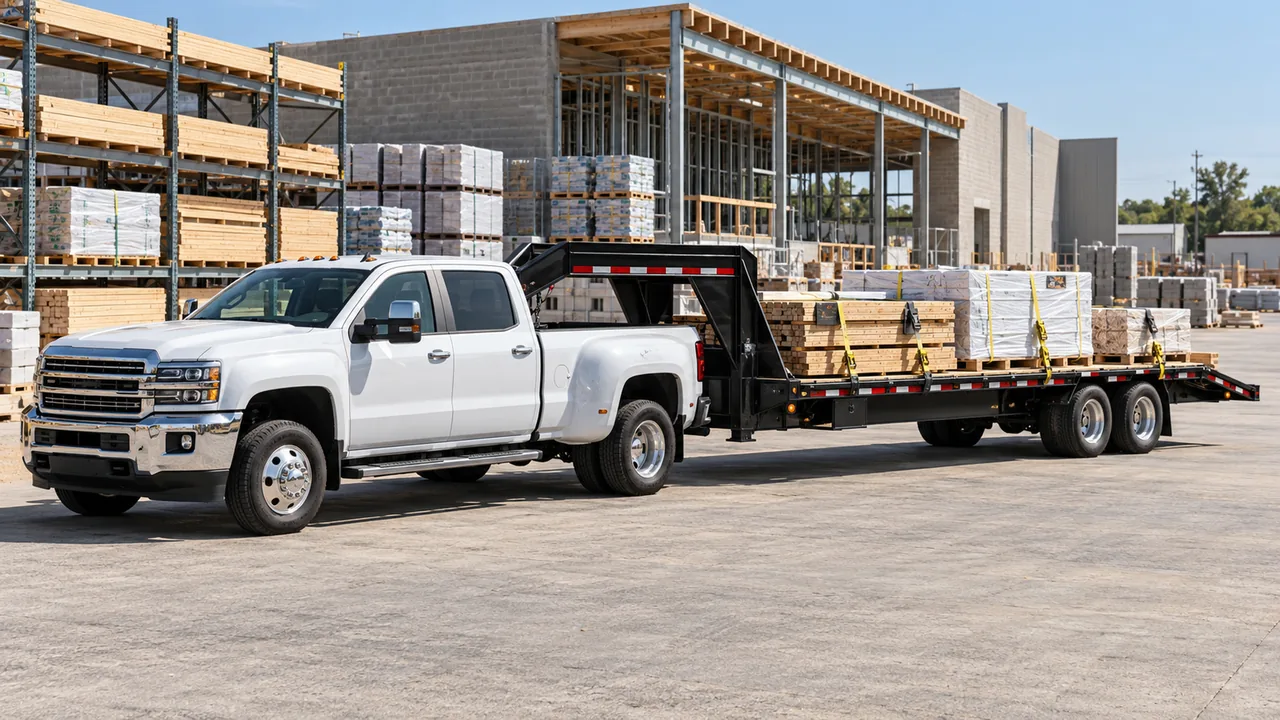
Trailers carry their own GVWR on a plate or sticker at the tongue or frame, and underwriters read it as carefully as the truck's. A single-axle utility trailer might be rated 3,000 lbs; a tandem landscape trailer somewhere around 7,000 to 10,000; a gooseneck or tag trailer hauling a compact excavator or skid steer can be rated 14,000 lbs or well beyond.
The license question depends on the pair. Under DMV's license classes, a driver needs a Class A when the combination is rated at 26,001 lbs or more and the trailer's own plate shows more than 10,000 lbs. A one-ton pickup pulling a 14,000-lb gooseneck often crosses that line, while the same pickup with a 7,000-lb utility trailer usually doesn't. Buy trailers with your drivers' licenses in mind.
Trailers are the only entry without an engine on our commercial truck insurance quote hub. Combinations can change which permits apply; the page on California commercial truck insurance requirements takes that up in detail.
Underwriters tend to see a trailer through the truck pulling it. A towed load lengthens stopping distance, widens every turn and adds sway at speed, and the claims follow: jackknifes on wet on-ramps, trailers that drift into the next lane on a curve and backing collisions at job sites where the driver can't see the trailer's far corner. A trailer that comes unhitched on the road is a claim underwriters often ask about.
So the questions are mostly about combinations: which truck pulls which trailer, what each trailer weighs loaded, whether it has its own brakes and a working controller and whether drivers check chains, couplers and lights before leaving the yard. Many carriers also compare the number of trailers to the number of trucks, because a yard full of trailers and only a few tow vehicles says a lot about how they're used.
Some trailers hardly move, like a storage trailer parked at a job for months. Others are hitched every morning. Tell us which is which, since it can affect how each is rated and whether it needs to be listed at all.
Liability for a crash involving a towed trailer usually runs through the towing truck's policy, so the truck's limit is the one that counts. That's a strong reason to keep it at the $1 million combined single limit most contracts expect. Where contracts allow, a truck can settle on $750,000, and the permit rules generally keep it at or above that figure once it tows a trailer rated over 10,000 lbs, since the pairing needs a Motor Carrier Permit. The $300,000 and $500,000 tiers are for light combinations outside the permit, and a trailer swinging across lanes can involve several vehicles at once.
Physical damage works differently. A trailer generally has to be listed with its year, VIN and value before comprehensive and collision can respond to a theft, fire or wreck. Our page on commercial truck physical damage insurance covers deductibles and valuation.
Trailers are easy to steal, since a thief with the right hitch can drive off with one. The CHP counted 7,331 trailers stolen in California in 2025. Hitch locks, wheel locks, GPS tags and fenced overnight parking all help, and underwriters tend to notice them.
Official sources
Eleven of our trades pull trailers, and in most of them the trailer carries more value than people expect.
Equipment and job-box trailers moved between sites.
General contractor commercial auto insuranceDump trailers for tear-off, emptied at the transfer station.
Roofing contractor commercial auto insuranceOpen trailers carrying mowers that are usually insured separately.
Landscaping truck and trailer insuranceFlat trailers for posts, panels and the auger.
Fence contractor commercial auto insuranceTrailers for excavation gear, plaster and pumps on build jobs.
Pool contractor commercial auto insuranceTag and gooseneck trailers for compact excavators and loaders.
Grading contractor truck insuranceEquipment trailers for rollers, plus tack and crack-seal units.
Paving contractor truck insuranceDrill and vacuum trailers that follow the crew truck.
Directional boring contractor truck insuranceA trailer's own premium is usually modest. The larger effect is often on the truck that pulls it and on how the account looks overall.
| Factor | How it affects a trailer |
|---|---|
| Trailer type and value | A new gooseneck equipment trailer costs far more to replace than an old single-axle utility trailer. |
| Trailers per truck | More trailers than tow vehicles usually means many sit idle, and underwriters ask which ones are in regular use. |
| Towing vehicle | The trailer's liability typically rides on the truck's rating, so a heavy trailer behind a light pickup draws questions. |
| Brakes and coupling | Trailer brakes, a working controller and maintained couplers help cut the odds of the claim many carriers fear most. |
| Parking and theft controls | Trailers left on streets or open lots are easy targets; locks, GPS and fenced storage help. |
| Driver training | Backing and turning with a trailer is a learned skill, and documented training shows it's taught. |
| Load securement | Equipment chained properly to the deck helps keep a shifted load from turning into a liability claim. |
Training records and camera footage are two of the measures covered on our page about fleet safety measures underwriters often credit.
Enclosed cargo trailers often serve as a rolling tool room, parked at a job for weeks and towed home on weekends. On the auto side, list the trailer with its value so a theft or fire to the trailer itself can be covered. The contents are the bigger exposure, and they usually sit on an equipment policy, not the auto. A trailer left at a site overnight is also a theft target, so a hitch lock and a GPS tag can earn their keep.
Towing a trailer you don't own is common: a rented equipment trailer for a big job, a supplier's trailer, a customer's boat or equipment for a repair shop. Your liability usually extends to it through the towing truck. Damage to the borrowed trailer itself may not be covered by your own physical damage unless the policy is endorsed for it, so ask before you hitch up. Many of these tows happen behind a contractor pickup, which is worth checking for towing capacity too.
Roofers, landscapers and small grading outfits often start with a dump trailer behind a one-ton pickup. It's flexible, and with a trailer rated 10,000 lbs or less and no placarded hazmat aboard, the driver generally doesn't need a CDL; the combination is still heavy when loaded and harder to back. When hauling becomes daily work, many move to a single-axle dump; our dump truck insurance for single-axle trucks page covers how those are rated, and business auto insurance for 1 to 4 vehicles explains how a small schedule is usually written.
Many California underwriters compare a fleet's trailer count with its tow vehicles because more trailers than trucks suggests many sit idle. They'll ask which trailers are hitched daily and which rarely move, since that shapes how each is rated.
A one-ton pickup pulling a 14,000-lb gooseneck often crosses into Class A territory. Owners who buy the trailer first sometimes find that most of their drivers can't legally tow it.
Trailers are easy to steal, and the CHP counted 7,331 taken in California in 2025. Hitch locks, wheel locks, GPS tags and fenced overnight parking are the controls underwriters tend to notice on an application.
Because liability for a towed trailer usually runs through the towing truck, a thin limit on that truck can cap what's available when a trailer swings across lanes and strikes several cars.
Timing depends on the carriers and your loss history.
Have ready: vehicle list with VINs, driver list, current declarations page, loss runs.
Next Level Experience. Insurance Done Right.
Fleet quotes for California businesses running up to 50 trucks and vans.