Service bodyGVWR
- Weight
- 10,001–19,500 lbs typical
- CDL
- No
- Trades
- Plumbing, HVAC, electrical, repair

Commercial auto for pool service routes and pool builders: chemical-carrying route pickups, dig crews' dump trucks and the trailers that move excavators and plaster rigs. Quoted with top-rated national carriers, whether you run one route truck or a full fleet.
Quick answer
Most California pool companies need one business auto policy covering route pickups, construction trucks and every trailer, with the chlorine and acid on board disclosed up front. Techs who drive their own trucks usually call for hired and non-owned coverage. Builders and HOAs usually expect the certificate to show a $1 million combined single limit.
Commercial Auto + Fleet Insurance
CaliforniaUp to 50 VehiclesWe’re here to help.
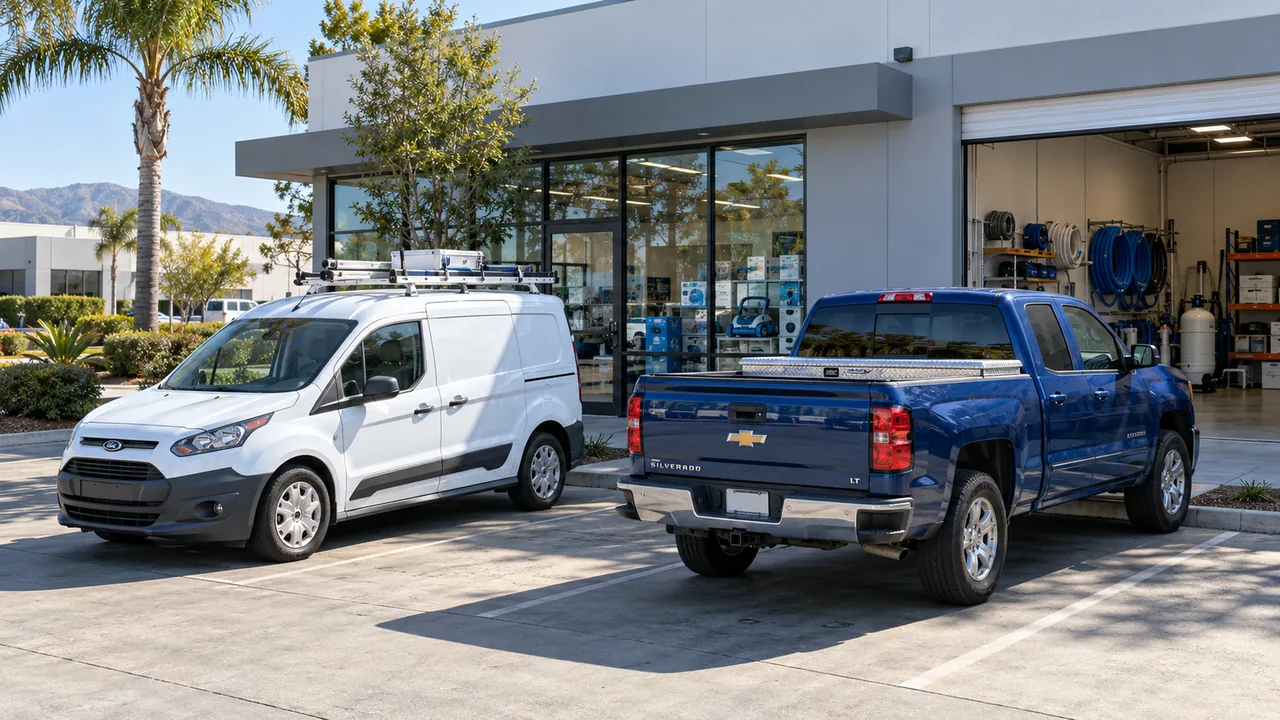
Pool service runs on compact and half-ton pickups set up as rolling chemical stores. A typical route truck carries liquid chlorine in carboys or a bed-mounted tank, jugs of muriatic acid, buckets of tablets and shock, a vacuum head and pole, test kits and a hose reel, with filter grids and pump parts in a lockbox. Some companies move techs into small utility-body trucks so chemicals ride in vented compartments away from the cab. Either way, the truck spends its day on residential streets, backing in and out of driveways and parking at the curb outside one backyard after another.
Construction is a heavier fleet. The dig crew tows a mini excavator or skid steer on an equipment trailer, and a small dump truck hauls spoil away from the hole, often several loads per pool down narrow streets. Steel, plumbing and electrical crews drive pickups and stake beds; shotcrete and plaster crews tow trailer-mounted pumps and mixers; tile and coping crews pull utility trailers stacked with stone. Remodel jobs add demolition debris and more runs to the dump. On a builder's schedule, commercial trailer insurance is the norm rather than the exception.
Nearly all of it sits under 26,001 lbs GVWR, so most pool drivers don't need a commercial license. The unit worth a second look is the loaded dump truck towing an equipment trailer: A trailer rated over 10,000 lbs generally calls for a Class A license, and a third axle on the dump can mean a Class B.
Liability does the heavy lifting on a pool account. The claims on pool loss runs tend to be close-quarters ones: a route tech backing out of a steep driveway into a car parked across the street, a dump truck clipping a gate at the end of a cul-de-sac, a trailer cutting a corner through a neighbor's landscaping. The serious ones often happen between stops, when a tech running behind on a long summer route rushes a left turn. Builders, homeowner associations and commercial property managers usually name a $1 million combined single limit; our pool quotes begin there, and commercial auto liability explains how the limit works.
Physical damage has a chemical twist. A cracked acid jug or incompatible chemicals allowed to mix can start a fire or eat through a bed, and a fire in the truck is usually handled as a comprehensive loss when you carry it. Slow corrosion from fumes is usually treated as wear and tear. Most carriers ask how chemicals are stored and separated before they quote physical damage on route trucks and want tanks, racks and lockboxes included in each truck's value.
Many service companies pay techs an allowance to drive their own pickups, or buy routes whose techs come with their own trucks. When a tech in a personal vehicle causes a crash between stops, the claim often names the company too. Hired and non-owned coverage can stand behind the business in that case; the tech's own policy generally still answers first and may exclude business use.
Expect the certificate request to read $1 million combined single limit. That's what pool builders' general contractors, HOAs and commercial pool owners typically ask for, and it's our default. A service company whose accounts are all homeowners may choose $300,000, $500,000 or $750,000 instead, though a serious injury claim from a driveway backing accident isn't capped by what a contract happened to require. Commercial accounts such as hotels, apartment communities, schools and parks departments often add additional insured wording and a waiver of subrogation; once we've read the contract, we ask the carrier to add both by endorsement.
Pool owners often ask whether the chemical load changes the filings. That generally turns on the quantities and packaging on each truck, a regulatory question rather than an insurance one, and our California truck requirements page points to the rules. The federal hazardous materials rules, for instance, include a materials-of-trade exception for small packaged amounts of corrosive and oxidizing products, and even that exception generally calls for leak-tight containers secured against shifting. What the carrier usually needs from you is a plain description of what each truck carries on an ordinary day.
A dump truck or truck-and-trailer combination that needs a Motor Carrier Permit generally also needs its insurance filed with the DMV. The MCP permit guide covers who needs one, and the carrier typically makes the filing after the policy is bound.
Official sources
GPS stop logs that show where a truck was and when, a one-page chemical handling rule kept in each truck and MVR checks before a new tech gets a route can give an underwriter concrete reasons to credit the account. Pool companies that pair techs with a trainer for their first weeks on a route can say so, too. Builders should expect questions about the dig crew as well: whether the dump truck ever hauls for another builder and where the spoil goes. Fleet safety and claims defense covers how camera footage can help settle a disputed driveway backing claim.
An owner-operator with one route pickup is usually quoted much like any small business auto policy, with the carrier's attention on the driver's record and what's in the bed. Five to ten trucks, often a handful of route pickups plus a builder's dump truck and trailers, typically moves you into fleet rating, where many carriers want written hiring standards and a consistent rule on take-home trucks. Small fleet insurance explains how that size is rated.
From eleven trucks up, seasonal turnover among techs, take-home trucks spread across many ZIP codes and the claim pattern over several summers tend to drive most of the price. Pool companies that grow by buying routes should call before closing: A route purchase can add trucks and drivers in a single week, and each should be on the policy before it rolls. Seasonal trucks can be added in spring by endorsement and taken off in fall the same way.
Mid-sized pool companies usually split the fleet in two: route trucks that sleep in techs' driveways across the metro and construction trucks parked at a central yard. Carriers generally rate each unit where it spends the night, so a schedule that lists everything at the office address may get corrected later, sometimes after a claim. Keep the garaging column current as techs move or change routes.
Most carriers don't see a pool builder and a pool service company as the same risk. A builder runs fewer, heavier vehicles (dumps, equipment trailers, stake beds) driven by crew leads who stay on one site most of the day. A service company runs many light pickups, each with one driver making many stops, and its exposure grows with every driveway a tech backs out of. Repair and equipment crews sit in between, carrying pumps, heaters and automation panels in larger vans or utility bodies, and should be listed as the install trucks they are. On the construction side, CSLB licenses builders under its C-53 swimming pool classification, whose scope, in CSLB's description, is building pools, spas and hot tubs.
Plenty of California pool companies do both, and that can work on one policy as long as each unit is described by what it actually does. A route pickup listed as a contractor's truck or a spoil-hauling dump listed as a service vehicle can put the wrong rate on the unit and invite questions after a claim. Our commercial auto guide covers how carriers price each unit, and the dump truck page goes deeper on dumps.
Some pool companies also run a retail store. Taking chemicals or equipment to homeowners' doors as a store service is home delivery, which isn't a program we place, so tell us if any truck does it.
Official sources
Damage to the truck itself is usually a comprehensive claim when you carry physical damage. The chemicals lost and any spill cleanup are separate questions.
Builders often list the dump truck and leave off the equipment trailer behind it. An unlisted trailer typically has no physical damage coverage if it's stolen from the yard or wrecked.
Route volume climbs with the heat, and so does hiring. Run MVRs before a new tech takes a route, not after the first fender bender.
When a tech's own pickup causes the crash, hired and non-owned coverage can keep the claim from landing on the business with nothing behind it.
Flatbeds and trailers loaded with posts and panels.
Commercial auto for fence installersTiming depends on the carriers and your loss history.
Have ready: vehicle list with VINs, driver list, current declarations page, loss runs.
Next Level Experience. Insurance Done Right.
Fleet quotes for California businesses running up to 50 trucks and vans.