Work pickupGVWR
- Weight
- Up to 14,000 lbs typical
- CDL
- No
- Trades
- Every trade

Commercial auto for civil, structural and geotechnical firms, land surveyors and testing labs: company SUVs and pickups, survey and field-testing trucks and the staff cars that make most of the trips. Quoted with top-rated national carriers.
Quick answer
Most California engineering firms need two things from commercial auto: a policy for the SUVs, pickups and field trucks they own, and hired and non-owned coverage for the employees who drive personal cars to sites and meetings. Public agency contracts often check for both. A consulting firm's quote from us opens with a $1 million combined single limit.
Commercial Auto + Fleet Insurance
CaliforniaUp to 50 VehiclesWe’re here to help.
An engineering firm's fleet is often smaller than its exposure. A typical office owns a handful of SUVs and crew-cab pickups assigned to project managers and field staff, while far more engineers drive their own cars to site walks, plan-check counters, client meetings and construction observation visits, then submit the miles for reimbursement. Most of a typical firm's driving happens in vehicles it doesn't own.
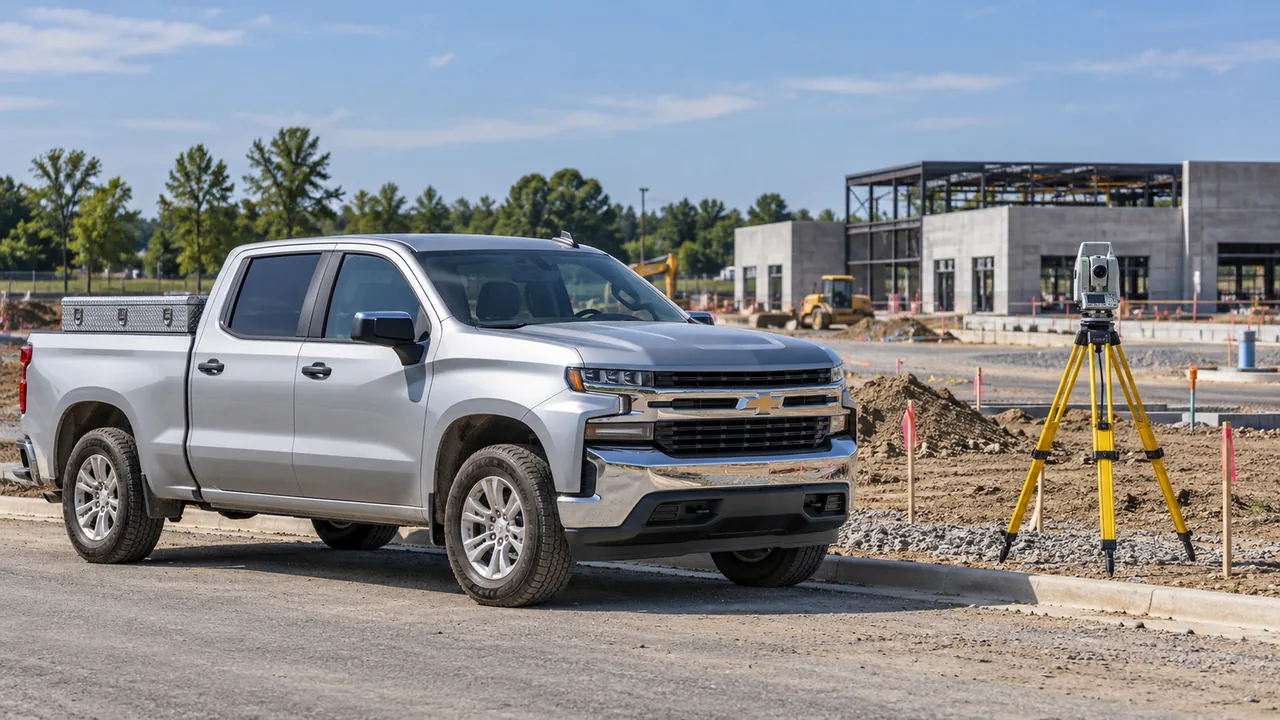
The field side runs real work trucks. Survey crews drive pickups with shells or utility bodies loaded with GNSS receivers, robotic total stations, tripods, lath, hubs and marking paint. Materials-testing and special-inspection technicians carry cylinder molds, slump cones, sample buckets and at many labs a nuclear density gauge locked in a box in the bed. Geotechnical and environmental teams add sampling gear and sometimes a trailer for a UTV that reaches the back of a site or for a small drill rig. Field crews start early and cover long stretches to canal and levee work, remote alignments and solar sites, often finishing on unpaved access roads that are hard on tires and windshields.
Nearly all of it sits well under 26,001 lbs, so field staff rarely need a commercial license. The rating questions are mostly about people: how many employees drive on firm business, whether field trucks go home with technicians, whether personal use is allowed and how far crews travel to rural projects in the Valley or the North State. Our page on insurance for company pickups covers the trucks themselves.
When an engineer rear-ends someone in a personal car on the way to a site meeting, the engineer's own auto policy generally pays first. If the injuries outrun that policy's limits, the injured person's attorney often looks to the employer, because the trip was firm business. Coverage for employees' own cars on company business is what can defend the firm and pay above the employee's policy at that point. California Insurance Code section 11580.9 generally sets that order: The policy describing the car as an owned vehicle is primary, and other coverage sits above it.
The same coverage usually extends to rental cars staff pick up for an out-of-town project and to a car borrowed from a colleague. It generally protects the firm's liability rather than the car. Damage to an employee's own vehicle typically stays with their personal policy, and a dented rental often calls for hired auto physical damage on your policy or the rental counter's waiver. Interns and junior staff are a frequent blind spot, since they're often the ones sent to the print shop, the county recorder or the hardware store in whatever car they happen to drive.
For vehicles the firm owns, liability and physical damage work much as they do for any business. A survey truck's scheduled value usually includes its shell, drawers and racks, but not the instruments inside. Public agency and developer contracts generally expect a $1 million combined single limit; we build engineering-firm quotes around it for that reason, and our business auto insurance hub covers the other coverages a policy can carry.
Official sources
Public agency contracts often set the terms. Many city, county, school district and water agency agreements ask consultants for auto liability covering any auto, or owned, hired and non-owned autos listed together, at a $1 million combined single limit, with the agency added as additional insured. A firm that owns no vehicles can often meet the requirement with hired and non-owned coverage alone, though that depends on the contract's wording, so send it over before you sign.
Lower limits of $300,000, $500,000 and $750,000 exist, but a consulting firm with public clients seldom gets to use them. The usual structure is the full million on auto, with an umbrella above it when a large project or agency asks for higher totals. Agency forms may also ask for a waiver of subrogation and advance notice of cancellation, and developers and private owners often write the same requirements in their own words; the certificate should answer what the form actually says, so we read it before binding.
Filings rarely come up. Company SUVs and light pickups seldom raise Motor Carrier Permit questions, but a geotechnical firm that runs its own drill truck should check that one unit against the California truck insurance requirements before it heads to a site.
Most underwriters also want to know who the drivers are, not only how many. A firm whose drivers are mostly senior engineers heading to an occasional site meeting usually looks different from one with a large team of field technicians on the road every day. The document that often helps most is a written vehicle-use policy naming who may drive for the firm, setting the personal-limit floor and requiring yearly MVR checks. Firms with one in place tend to have smoother renewals, and our page on driver safety programs underwriters look for shows what else carries weight.
Plenty of engineering firms own one or two vehicles or none at all, while employing a large staff that drives. For them the owned vehicles are a small part of the picture, and the non-owned piece, which many carriers rate partly on how many employees the firm has, is usually the bigger conversation. Expect most applications to ask for total headcount, how many of those people drive for work and a rough figure for yearly business miles. Business auto insurance for 1 to 4 vehicles covers the small-schedule side.
With five to ten company vehicles, usually survey trucks, inspection pickups and a few principals' SUVs, carriers typically rate a small fleet and look for driver standards that apply firm-wide. The non-owned exposure still matters: A firm with eight trucks and a hundred people on mileage has far more drivers than vehicles. Fleet insurance for 5 to 10 vehicles explains how that size is underwritten.
At eleven to fifty vehicles, typically a multi-office firm with its own survey and testing departments, garaging spreads across offices, take-home rules differ by department, and loss runs tend to carry most of the weight. Keep one firm-wide vehicle list with each unit tied to an office, so a truck moved from Sacramento to Fresno doesn't fall off the schedule. Add pickups bought for a new field team before their first site visit and remove sold vehicles promptly so the policy isn't carrying trucks the firm no longer owns.
For many firms, most of the auto risk sits in cars they don't own, so much of the paperwork lives with HR rather than in a fleet file. Ask everyone who drives for work to sign the vehicle-use policy, hand over a copy of their personal auto declarations each year and report a suspended license or an accident promptly. Decide in advance what happens when a personal policy lapses; the simplest rule is that nobody drives on firm business until proof of current coverage is back on file.
Mileage reimbursement generally doesn't move liability. Paying for business miles covers fuel and wear; it typically doesn't change who gets named after a crash, and it won't make an employee's thin personal limits any larger. That's why many firms set a minimum personal limit for anyone driving on firm business and check it every year; the Vehicle Code section 16056 floor is generally read as the least a personal policy may carry. The mileage check itself is an expense matter: It's one way a firm addresses Labor Code section 2802, which generally requires employers to cover the necessary expenditures employees incur doing their jobs. Passengers raise the stakes: When a project manager drives a city inspector or a developer's representative to a site in a personal car, an injured passenger's claim typically lands first on the employee's policy and can then reach for the firm.
Car allowances and company cars are usually rated differently. An allowance keeps the vehicle in the employee's name, on their policy, with the firm leaning on non-owned coverage. A company car moves it onto your schedule, under your limit and your loss history. Firms shifting from one model to the other should tell us, because the rating tends to follow the change.
Official sources
If staff drive for work, usually yes. Hired and non-owned coverage can be written on its own, and many public contracts look for it.
Personal limits can run out quickly in a serious injury case, and the firm is often next in line. Non-owned coverage is what can stand behind them.
Public clients may reject a certificate that shows owned autos only. We check the policy's coverage wording against the contract before the certificate goes out.
Hired and non-owned coverage generally handles liability, not the rental car itself. Add hired physical damage or take the rental company's waiver.
Low-voltage vans, mostly in town.
Commercial auto for alarm and securityCrane-body trucks working in the field.
Commercial auto for equipment repairTiming depends on the carriers and your loss history.
Have ready: vehicle list with VINs, driver list, current declarations page, loss runs.
Next Level Experience. Insurance Done Right.
Fleet quotes for California businesses running up to 50 trucks and vans.