Can an Inland Empire sub carry a lower limit?
Sometimes. Inland Empire contractors may be able to pick $300,000, $500,000 or $750,000 where contracts allow, but most warehouse and tract subcontracts there ask for a $1 million combined single limit.

Commercial auto for the contractors, suppliers and service fleets of western Riverside County and the San Bernardino Valley, where warehouse construction, new subdivisions and heavy truck traffic often shape how policies are written.
Quick answer
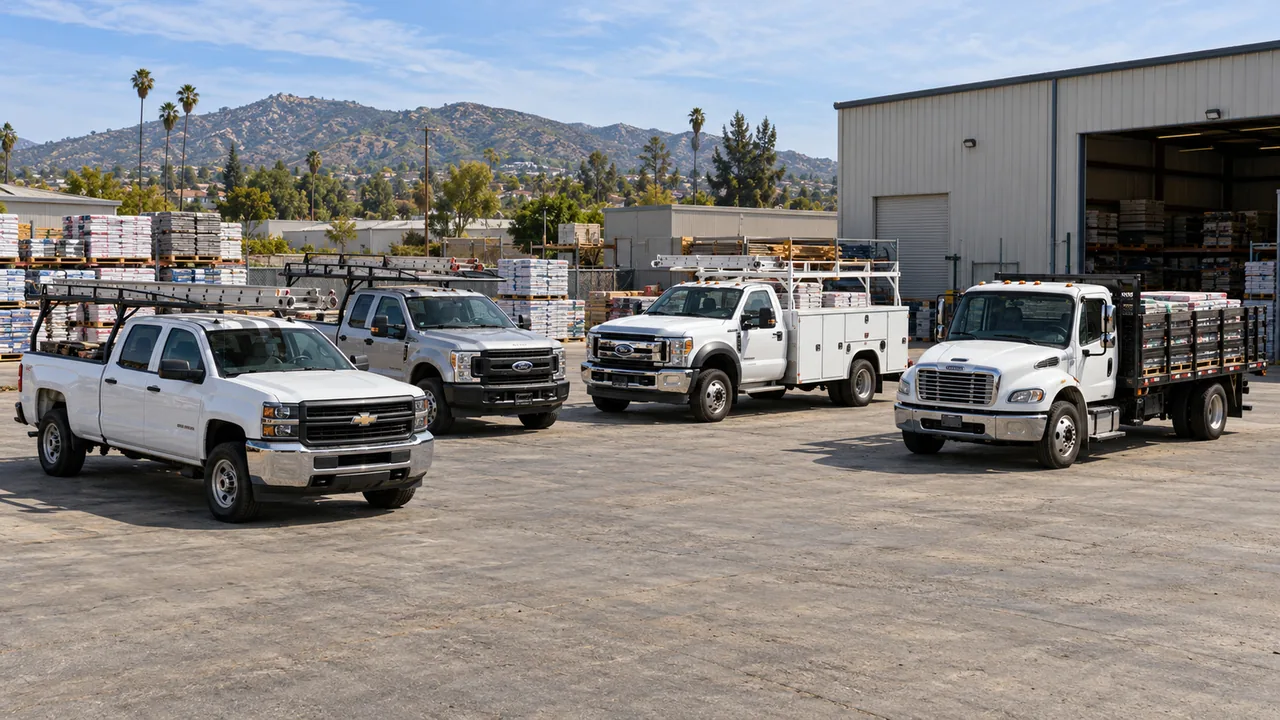
An Inland Empire contractor usually needs auto coverage built for distance: trucks that cover Temecula to Fontana in a day, trailers parked at home and freeways shared with warehouse freight. Every pickup, dump and trailer can sit on one policy, each rated at its overnight address, and quotes for these fleets typically open at a $1 million combined single limit with national carriers.
Commercial Auto + Fleet Insurance
CaliforniaUp to 50 VehiclesWe’re here to help.
Distance is the Inland Empire's defining fact. A framing crew based in Menifee might work a tract in Fontana one month and Beaumont the next, and a supplier in Ontario can reach builders' job sites in Temecula, Redlands and Corona in a single day. The I-10 carries the east–west load from Ontario through Fontana and Redlands to the San Gorgonio Pass, the I-15 runs north–south from Temecula through Corona and Ontario toward the Cajon Pass, and the I-215 links Murrieta, Perris, Moreno Valley, Riverside and San Bernardino. SR-60 crosses Jurupa Valley, Riverside and Moreno Valley before climbing the Badlands to Beaumont, and SR-91 through Corona is the main line to Orange County.
These are freight freeways. Around the I-10 and I-15 interchange in Ontario and along the warehouse districts of Fontana, Rialto, Moreno Valley and Perris, a contractor's pickup and trailer spend much of the day beside tractor-trailers, and the merges, lane changes and sudden slowdowns that come with that traffic are what a defensive-driving rule for an IE crew should be about. A crew that leaves at five to beat the 91 into Orange County, or sits in the afternoon backup on the 60, is putting long, tiring hours on its drivers, which is why underwriters often ask about radius and daily mileage.
Garaging is mixed. Many contractors here run from home, with pickups in the driveway and trailers along the side yard or on the street, while larger fleets keep yards in the industrial areas of Ontario, Fontana, Riverside and Perris. Equipment trailers parked on residential streets are an easy target, and a fenced, lit yard can change the conversation with an underwriter.
Weather swings hard. Santa Ana winds in fall and winter can bring high-wind advisories for trucks and trailers below the Cajon Pass and through Fontana and Rialto, summer heat in the inland valleys wears on tires, brakes and batteries, and storms can send flash floods and mud across roads below the foothills. Crews who climb the pass to Victor Valley jobs should also read our High Desert truck and fleet insurance page.
We write fleets based across western Riverside County and the San Bernardino Valley. These are the cities this page names, with their populations:
Official sources
Two kinds of building drive the Inland Empire: warehouses and houses. Tilt-up distribution buildings in Ontario, Fontana, Rialto, Moreno Valley, Perris and Eastvale start with pad grading and end with parking lots, and grading contractors' dump trucks and paving crews run the first and last weeks of every one. In between, electrical contractors wiring warehouses run vans and service trucks, and fire sprinkler, roofing and HVAC trades follow.
New subdivisions in Menifee, Murrieta, Temecula, Lake Elsinore, Beaumont and Eastvale keep residential trades moving in waves: grading and utilities first, then framing crews with flatbeds and trailers, drywall, roofing, plumbing and landscaping. Building material suppliers move lumber, drywall and roofing from yards along the I-10 and I-15 to builders' job sites and contractors' yards all over both counties; supplier delivery trucks and flatbed and stake bed trucks have their own pages.
Warehouse operators' own line-haul rigs and for-hire freight are outside what we write; the trades that build, wire and maintain those buildings are squarely inside it. Most of their trucks are pickups, flatbeds, single-axle dumps and equipment trailers, usually rated 45,000 lbs and under, and the commercial auto policy for contractor fleets written for them generally starts at a $1 million combined single limit, with $300,000, $500,000 or $750,000 possible where a contract allows.
Cities generally have the power to keep heavy trucks off residential streets. In broad terms, Vehicle Code Section 35701 lets a city close streets to commercial vehicles, or to vehicles over a set weight, once signs are up, and Section 35703 keeps that kind of rule from blocking a truck that leaves an open street by the most direct route to load or unload at a building on the restricted street, or to bring materials to a building with a permit.
In practice, a dump truck or flatbed leaving a job should get back to a posted truck route the short way, not cut through a subdivision to save five minutes. A ticket isn't a claim, but a crash on a street the truck had no business using is usually harder to defend. Check each city's truck route map when you bid work there; our requirements guide covers the state permits and filings.
Official sources
Fontana is the Inland Empire's dump truck page, and it covers the haul routes between quarries, warehouse pads and new tracts in the San Bernardino Valley. For coverage and the 45,000-lb focus, start at dump truck insurance in California.
NICB counted 14,111 vehicle thefts in the Riverside–San Bernardino–Ontario metro area in 2025, the ninth-highest total in the country, and trailers left on streets and unfenced lots are a familiar loss; theft hot spots in the Inland Empire covers yard security and the tools auto coverage usually doesn't pay for.
Staged collisions are a documented local problem. A 2023 Department of Insurance case out of Yucaipa alleged about 23 deliberate collisions and 17 claims, including one in which a truck pulling a trailer rear-ended the suspect's vehicle, and a 2026 staged-crash case in Upland and Montclair was worked by the Inland Empire Auto Insurance Fraud Task Force; how staged accidents target commercial vehicles explains why a forward camera can matter.
The region's other hazards have their own guides: the I-10, I-15 and Cajon Pass claim corridors, wildfire season for Inland Empire fleets, flash floods and atmospheric rivers in the Inland Empire and earthquake planning for Inland Empire trucks.
Official sources
Sometimes. Inland Empire contractors may be able to pick $300,000, $500,000 or $750,000 where contracts allow, but most warehouse and tract subcontracts there ask for a $1 million combined single limit.
A loaded dump leaving a Menifee or Eastvale tract sometimes cuts through residential streets instead of heading back to a posted truck route, and a crash on a street closed to it can be much harder to defend.
An Inland Empire crew that rolls out before dawn to beat SR-91 into Orange County, then sits in the afternoon backup on SR-60, is putting in long, tiring hours, and a cap on daily driving time can show a carrier the owner has noticed.
An Inland Empire contractor that grades, wires or roofs distribution buildings is usually written as a contractor fleet, but adding a tractor-trailer that hauls freight for hire would put that truck outside what we place.
Timing depends on the carriers and your loss history.
Have ready: vehicle list with VINs, driver list, current declarations page, loss runs.
This page covers fleets garaged anywhere in the region. These are the 76 cities and 128 ZIP codes within 30 miles of Riverside and 25 miles of San Bernardino. Cities with their own page here are linked.
Next Level Experience. Insurance Done Right.
Fleet quotes for California businesses running up to 50 trucks and vans.