Cargo vanGVWR
- Weight
- Up to 10,000 lbs typical
- CDL
- No
- Trades
- HVAC, alarm, painting, flooring

Commercial auto for flooring contractors whose high-roof vans carry plank, tile, carpet rolls and the saws to cut them and whose box trucks move pallets to the job. One van or up to 50 vehicles, with top-rated national carriers.
Quick answer
Flooring contractors generally need commercial auto on each van and box truck, with drivers listed and each van's upfit valued. Most commercial contracts call for a $1 million combined single limit. The policy is meant for the vans, not the material or the saws inside: Flooring in transit and tools usually need inland marine, and subcontract installers' vans belong on their own policies.
Commercial Auto + Fleet Insurance
CaliforniaUp to 50 VehiclesWe’re here to help.
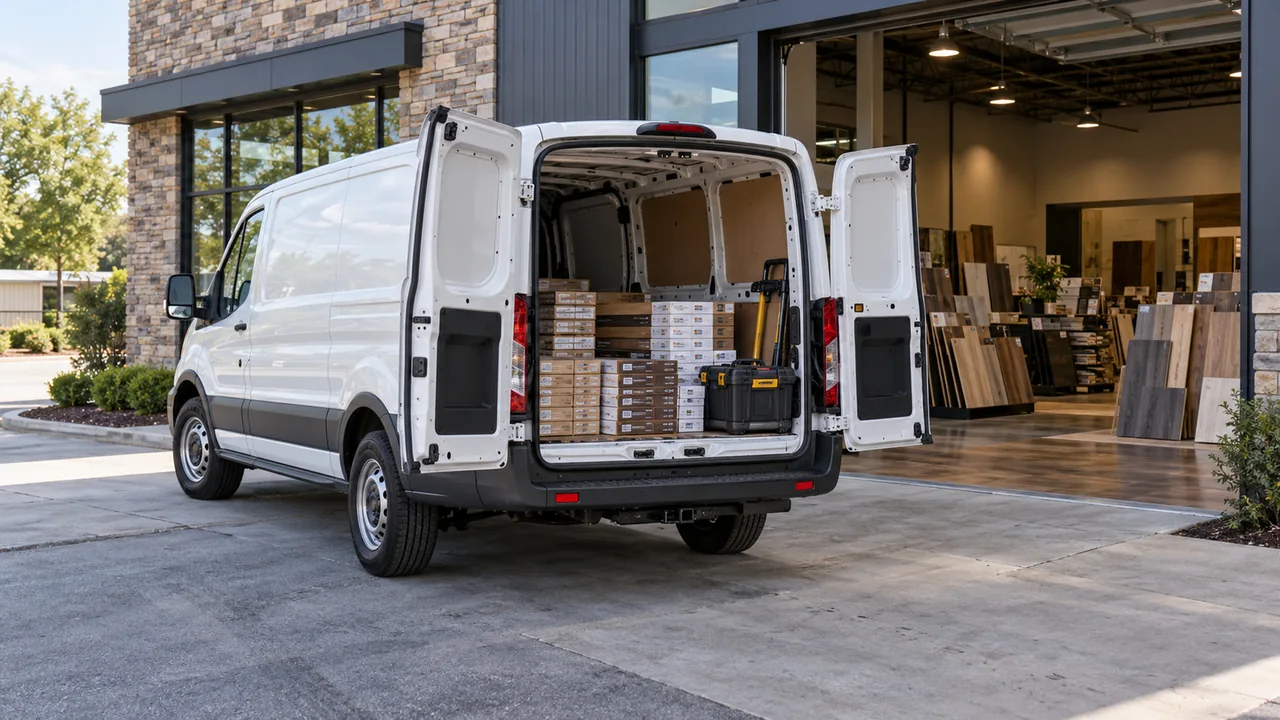
Flooring runs on cargo vans. High-roof Sprinters, Transits and ProMasters carry boxes of plank and laminate, cartons of tile, bags of thinset and self-leveler, rolls of pad and the tools that go with each job: wet saws, miter and jamb saws, undercut saws, knee kickers and power stretchers, floor scrapers and, for refinishers, drum sanders, edgers and buffers. Larger flooring contractors add a box truck to carry twelve-foot carpet rolls and pallets of product from the distributor to the job. Licensing follows the material: CSLB's C-15 Flooring and Floor Covering classification takes in carpet, vinyl-type products and hardwood, and it leaves ceramic tile out.
The jobs are scattered. A residential crew might finish a bathroom in one house and start a living room across town. Commercial crews work in offices, retail and multifamily, often at night or on weekends so a store can stay open, and they park in garages with low clearance and at loading docks with tight time slots. Tract-home flooring crews follow the builders from phase to phase. Hardwood refinishers keep their own rhythm: A coat of finish often can't be walked on for hours, so the van moves between several houses in a day while each floor cures.
Vans and most box trucks used for flooring are rated under 26,001 lbs GVWR, so a commercial license is rarely needed. Payload is the real limit. Tile, stone and luxury vinyl are dense, and a van can reach its rated weight long before it looks full. Insurance for work vans goes further into how carriers rate them.
Official sources
Liability is designed to protect you from what your vans do to others: a heavy van that needs too much room to stop, a box truck that clips a parked car in a narrow alley, a crew lead who backs into a pillar in a condo garage and damages someone's car. Commercial and multifamily general contractors typically ask flooring subs for a $1 million combined single limit with additional insured status. Auto liability for contractor vans explains how limits work. Night crews add a wrinkle of their own: An installer driving home after a store reset that ran past midnight is a tired driver, and many underwriters ask how late shifts end.
Physical damage is what usually repairs or replaces the vans themselves. High-roof vans meet low clearances in parking structures and carports, and a roof strike is generally a collision claim. List the shelving, partitions and racks when the van is scheduled, so a total loss can account for the build-out too. Read about comprehensive and collision for flooring vans.
Flooring also leans on installers who aren't employees. Subcontract installers should carry their own auto coverage, and you should keep their certificates on file. When one of them causes a crash on the way to your customer's job, your company can still be named, which is where hired and non-owned coverage fits.
Our flooring quotes open with a $1 million combined single limit, because commercial GCs, property managers and retailers' installation programs usually ask for it. A flooring store or installer working mainly for homeowners can choose $750,000, $500,000 or $300,000 if no contract asks for more. Before choosing, check any installation agreement you've signed with a retailer or distributor; many specify the auto limit and how certificates should read, and some add a waiver of subrogation that usually has to be requested as an endorsement before the first job.
Property managers who hire you directly for apartment unit turns often want both the management company and the owner named as additional insured. Send the exact entity names; a certificate showing the wrong LLC can hold up a payment until it's reissued.
Retail installation programs work the same way from the other side. A large flooring retailer that sends you its customers' jobs usually requires you to carry your own auto and name the retailer as additional insured. The program agreement, not the homeowner, typically sets that requirement, so keep a copy with your insurance papers.
Filings are uncommon for vans. A larger box truck that moves pallets between your warehouse and jobs is worth checking against the Motor Carrier Permit rules before it goes into service.
A flooring company that weighs a loaded van once, posts the roof height on the dash and puts cameras on the box trucks shows an underwriter it manages the details. Fleet safety measures that carriers credit explains why those habits can matter at claim time.
If your installers are paid by the job, expect a question about how they're classified. The answer matters most for workers' comp, but it can also shape how much weight the underwriter puts on non-owned auto exposure and on who is really driving your company vans.
A one-van installer, often an owner who installs for a flooring store, is usually rated on the owner's driving record, the van and where it sleeps. Getting the van onto a business policy, rather than a personal one, is usually the first step. Installers who take work from more than one store should say so, because a van serving three showrooms covers more ground than one tied to a single retailer.
At five to ten units, a flooring contractor has several crews, a van per crew and possibly a box truck. Carriers typically want to see who drives what and whether subcontract installers ever take company vans. Small fleet coverage for five to ten vans explains how that's rated.
From eleven to fifty, the business usually has a warehouse, a scheduler, box trucks running pallets to job sites each morning and crews spread across a metro. Underwriters tend to focus on driver screening, the loss trend and how you separate employees' vans from subcontractors' vehicles. A showroom with its own delivery van should list it apart from the install vans, since it makes more stops and different ones. Add a van before it carries its first load, not after.
Flooring material is heavier than it looks. A van stacked with tile cartons and thinset bags can pass its payload rating with the doors still open, and an overloaded van stops long, wears brakes and tires fast and handles badly in a lane change. If a crash happens, an adjuster may ask what was in the back.
The fixes are simple. Weigh a typical loaded van once at a public scale so crews know what full looks like. The number to compare it with is already in the van: On vehicles rated 10,000 lbs GVWR or less, federal standard FMVSS 110 calls for a placard on the driver's side door pillar giving the most that occupants and cargo together should weigh. Put heavy cartons low and forward, over the axles, and keep the saws strapped. Install a bulkhead between the cargo area and the cab, because a box of plank sliding forward in a hard stop can injure the driver. Store adhesives and finishes upright and sealed, away from the saws.
Carpet rolls deserve their own note. A twelve-foot roll in a van that's too short ends up angled over the passenger seat or hanging out the rear doors, and neither belongs in traffic. That's the job the box truck is for.
None of this changes what the auto policy covers, but it can change the claims you'll have. Fewer hard-stop injuries and fewer brake and tire breakdowns on the freeway tend to make the next renewal easier to place. Commercial auto for California trades has more on how the policy itself works.
Official sources
If hired auto coverage is on your policy, a truck you rent for a large job is generally covered for liability. Without it, you'd be relying on whatever the rental company sells at the counter.
When a subcontract installer borrows a company van, the carrier may treat them as an unlisted driver. Decide who may drive company vans and write it down.
Tall vans meet low beams in condo and retail garages. A label on the dash with the van's height is a small habit that helps head off roof claims.
A partition between cargo and cab helps keep a box of tile from hitting the driver in a hard stop. That's an injury avoided, not just an auto claim.
Painting contractors' vans and ladder racks.
Commercial auto for painting contractorsGeneral contractors running pickups and dumps.
Commercial auto for general contractorsDrywall crews with stake beds and taper vans.
Commercial auto for drywall contractorsTiming depends on the carriers and your loss history.
Have ready: vehicle list with VINs, driver list, current declarations page, loss runs.
Next Level Experience. Insurance Done Right.
Fleet quotes for California businesses running up to 50 trucks and vans.