
Dump truckGVWR
- Weight
- Focus: 45,000 lbs and under
- CDL
- Class B over 26,000 or any 3-axle
- Trades
- Grading, paving, landscaping, GCs
Commercial auto for grading and excavation contractors: single-axle dumps, foremen's pickups and the equipment trailers behind your work trucks. Our markets are strongest at 45,000 lbs GVWR and under, with top-rated national carriers.
Quick answer
Grading and excavation contractors usually need one commercial auto policy for dump trucks, pickups and equipment trailers. Single-axle and medium-duty units at 45,000 lbs GVWR and under usually get the strongest markets; heavier tandems have options, often less competitive. The machine on the trailer is generally treated as equipment, not auto.
Commercial Auto + Fleet Insurance
CaliforniaUp to 50 VehiclesWe’re here to help.
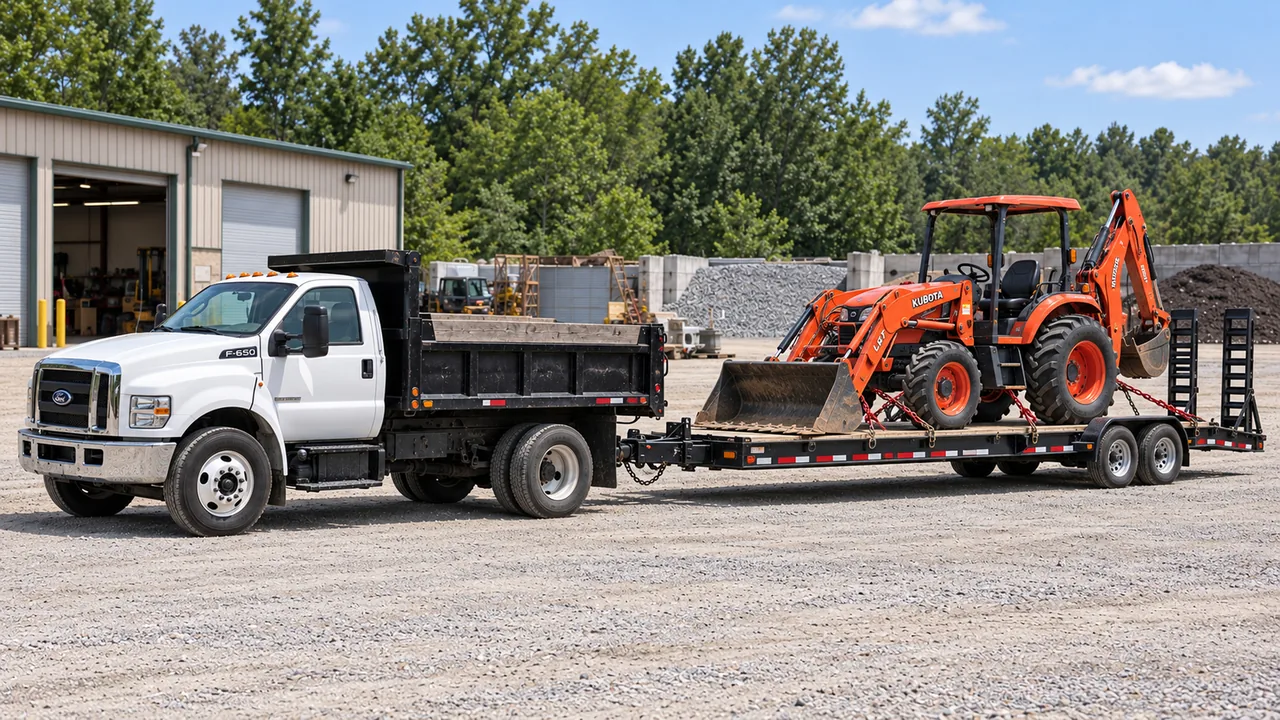
A typical earthwork yard keeps a pickup for every foreman and superintendent, a few single-axle dump trucks and one or two heavy work trucks (a 1-ton or medium-duty chassis with a flatbed) that tow gooseneck and tag trailers. Those trailers move skid steers, compact track loaders, mini excavators, backhoes and smooth-drum rollers from pad to pad. Bigger operators add a fuel and lube truck, a water truck for dust control and a lowboy behind a tractor for the dozer and the large excavator.
The dump trucks put on most of the miles. They haul spoil off a site, bring in base rock and import fill and cycle between the job and a dump site or recycling yard several times a day, starting each trip on a dirt haul road and finishing it on surface streets past new homes and schools. That loaded, repetitive driving is usually what an underwriter prices first. Superintendents' pickups rack up miles of their own, bouncing between active pads, the yard, the building department and the parts counter, and they're usually the vehicles that go home at night.
Weight largely decides which markets compete. Single-axle and medium-duty dumps and work trucks at 45,000 lbs GVWR and under tend to get the strongest response from our carriers. Heavier tandems and transfer rigs have options, often less competitive, and we'll say so before you fill out an application. Some contractors spec a single-axle dump just under 26,001 lbs so a crew member without a commercial license can generally drive it, which widens the driver pool even though the carrier still looks hard at who's behind the wheel. Our dump truck insurance page covers dump bodies in more depth.
Dump trucks usually carry most of the liability exposure in a grading yard. A loaded truck needs more room to stop, rolls through intersections in subdivisions that are filling with new residents and backs constantly on sites where laborers, surveyors and other trades are working on foot. Rock thrown from an untarped load into the windshield of the car behind is a small claim that can repeat all season. Developers and general contractors typically write a $1 million combined single limit into the subcontract; we treat it as the opening number for earthwork fleets.
Physical damage on the dumps is worth pricing on anything newer or financed, and dump bodies bring their own losses: a raised bed that catches a power line or an overpass, a truck that tips while dumping on soft fill, a bed left up and driven under a structure. List tarping systems, pintle hitches and other upfits so each unit's value is right; comprehensive and collision for dump trucks explains the choices.
Schedule every equipment trailer with its own value. Grading claim files often involve one: a load that shifted under hard braking, a gooseneck that jackknifed on a ramp, a boom left too high that struck a bridge. Equipment trailer insurance explains how trailers sit on the auto policy.
Grading subcontracts, developer agreements and public works bids usually ask for $1 million combined single limit auto, so that's the quote we build first. A contract that genuinely permits less opens up $300,000, $500,000 or $750,000, though with loaded dumps on public streets most contractors keep the full million. Public agencies and larger developers sometimes want more than $1 million in total; that layer usually comes from an umbrella policy, placed separately from the auto.
Dump trucks often bring license, permit and inspection questions that pickups don't. A truck rated 26,001 lbs GVWR or more generally needs a driver with a commercial license, and dumps frequently raise Motor Carrier Permit and CHP inspection questions; we won't restate the thresholds here. California truck insurance requirements and the MC 65 M filing guide lay them out, and when a filing is required, the carrier generally sends it to the DMV after the policy is bound.
One more point: A truck that hauls for other contractors for pay is usually doing for-hire trucking, which most carriers rate and file differently from trucks working your own jobs. Tell us before that starts, not after.
Certificates on grading work often go to several parties at once: the developer, the general contractor and sometimes the lender or the city that issued the grading permit. Send each request's wording so we can ask the carrier for endorsements that fit each one.
Contractors who tarp every load, put a spotter behind any truck backing on site and keep a written pre-trip inspection for dumps and trailers tend to present well. So does a short rule on who may tow which trailer. Fleet safety measures underwriters often credit explains how camera and telematics records can hold up when a claim is contested.
Maintenance comes up too. Hoists, tailgate latches, tarp arms and trailer brakes take a beating on dirt sites, and a maintenance log for each unit, with brake and tire checks dated, can help answer the hard questions after a rollover or a trailer that broke loose.
An owner with one dump truck and a pickup is usually written on a small business auto form, and the driver's record and the truck's weight do most of the talking. At five to ten units, often three or four dumps with pickups and trailers, carriers typically treat you as a fleet and want the same driver rules across the yard; fleet insurance for 5 to 10 vehicles explains how carriers rate that size.
Larger grading fleets swing with the building cycle. Trucks come on when a big subdivision or commercial pad breaks ground and sit idle when it finishes. Carriers usually handle that with endorsements in both directions, so add a truck before it starts hauling and take it off when it's sold, not at renewal. A truck parked for a slow stretch can sometimes drop to comprehensive only while it sits. From 26 trucks up, insurance for an established fleet turns mostly on your safety program and loss trend, and the full range of trucks we write is on the commercial truck insurance hub.
When a big job needs more trucks than you own, the owner-operators you bring in to haul should carry their own auto insurance. Collect their certificates before the first load, because a crash involving an uninsured hauler on your project can find its way back to you.
An equipment trailer is easy to steal: back up, drop the coupler on the ball, drive away. CHP's 2025 Vehicle Theft Facts counted 7,331 trailers stolen in California that year, and commercial truck thefts fell only 5.06% while thefts overall dropped 24.3%. For a grading contractor, a stolen trailer usually means the machine on it went too, and those are typically two claims on two different policies: the trailer under auto physical damage if it's scheduled, the machine under the equipment floater.
Many underwriters ask about the yard because an unattended yard is where these losses tend to start. A locked gate, hitch and wheel locks on parked trailers, GPS trackers hidden on both the trailer and the machine, fencing and lighting can all help, and so does not leaving a loaded trailer at an open job site over a weekend. If trucks and trailers park at different sites during a long project, tell us where. Trucks deserve the same care: A dump left at a job site overnight with the keys inside invites an easy loss, and a key-control rule costs little. Photograph each trailer's VIN plate and keep the machines' serial numbers on file; a recovered trailer with a ground-off plate can be hard to prove as yours.
Official sources
Tandems over 45,000 lbs GVWR have options, often less competitive. Single-axle and medium-duty dumps tend to get the strongest response, and a yard with both can often stay on one policy.
Scheduling the trailer generally doesn't insure the excavator chained to it. The machine typically needs its own equipment coverage, so a stolen trailer and machine often means two claims, with one of them on auto.
Once a truck hauls for other contractors for pay, it's generally a for-hire risk. Most carriers want to hear that before it starts, not at renewal.
A covered load helps keep rock in the bed. Fewer glass claims from the cars behind can make for quieter loss runs and fewer arguments with the drivers who were following.
Hot-mix dumps, crew trucks and roller trailers in traffic.
Commercial auto for pavingDrill and vac trailers working along road shoulders.
Commercial auto for directional boringNext Level Experience. Insurance Done Right.
Fleet quotes for California businesses running up to 50 trucks and vans.