
Dump truckGVWR
- Weight
- Focus: 45,000 lbs and under
- CDL
- Class B over 26,000 or any 3-axle
- Trades
- Grading, paving, landscaping, GCs
Commercial auto for asphalt paving companies: dumps hauling hot mix, crew trucks, tack rigs and the trailers that move rollers and pavers. Written for crews that work beside live traffic, with top-rated national carriers.
Quick answer
Paving contractors usually need one commercial auto policy covering hot-mix dumps, crew trucks and every trailer, from the roller trailer to the arrow board. Traffic-zone work and night shifts often shape how carriers read the account, and agencies commonly spell out a $1 million combined single limit in their contracts. Pavers and rollers usually count as equipment, not auto.
Commercial Auto + Fleet Insurance
CaliforniaUp to 50 VehiclesWe’re here to help.
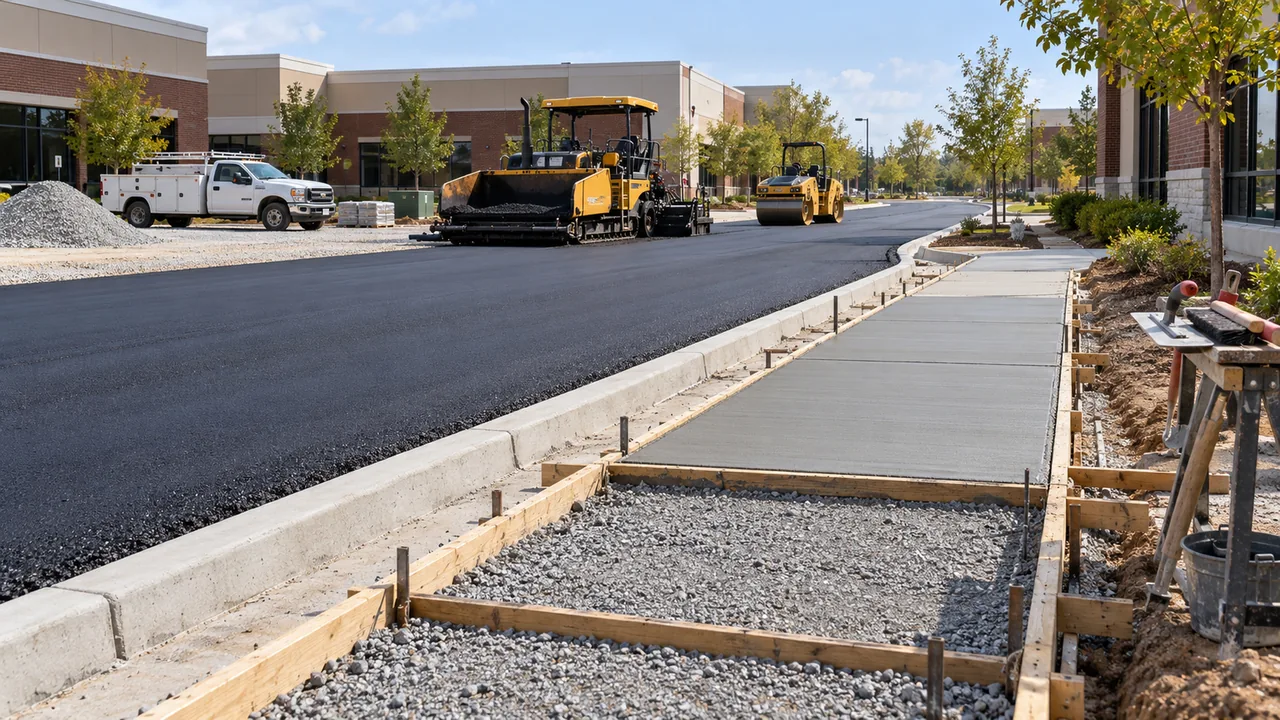
A paving crew moves as a convoy. Dump trucks load hot mix at the asphalt plant and run it to the job under a tarp to hold the heat. A crew truck, usually a crew-cab flatbed or stake bed, carries rakes, lutes, a plate compactor, cones and the people who use them. A heavy pickup or medium-duty truck tows a tag trailer with a roller or a small paver, and many companies add a tack truck or trailer-mounted tack tank, a crack-seal melter on its own trailer and an arrow board trailer for lane closures.
Sealcoat and striping outfits run lighter: pickups or small flatbeds carrying sealer tanks and spray rigs, and pickups or vans with walk-behind striping machines in the back. Parking lot paving companies sit between the two, often working nights and weekends when retail lots and apartment complexes are empty. Grind-and-pave crews add a sweeper truck to clean the cut before the mat goes down, and it belongs on the schedule like any other unit.
Hot-mix dumps are where weight becomes a question. Single-axle and medium-duty dumps at 45,000 lbs GVWR and under generally draw our strongest markets, while heavier tandem and transfer units can still be placed, usually less competitively. A large paver normally rides a lowboy behind a tractor, and that combination needs its own conversation. Insurance for dump trucks goes deeper on dump bodies. On the license side, CSLB's C-12 earthwork and paving classification, by CSLB's own description, takes in the mixing and placing of paving and other surfacing materials along with the grade beneath them.
Official sources
Few trades spend the workday parked inside a lane closure a few feet from moving traffic, and paving claims come from both directions. A dump backing to the paver hopper can strike a crew truck or a car edging past the closure; that typically lands on your liability coverage. A distracted driver who comes through the cones and hits a parked truck is likely at fault, but that driver isn't always insured, which is where uninsured motorist coverage for company vehicles can pay for injuries to the people in your truck.
Cities, counties, school districts and commercial property managers generally list a $1 million combined single limit in their requirements, and we write paving quotes to that figure first; how much auto liability a paving fleet needs walks through the reasoning.
Physical damage is worth pricing on newer or financed dumps and crew trucks, and hot work adds its own losses, such as a melter fire on a crack-seal trailer. Overspray is a claim most paving owners know: tack coat, sealer or striping paint landing on parked or passing cars. Depending on what caused it, the claim can fall to the auto policy or the general liability policy, so the two should be written with that overlap in mind.
Public works paving usually comes with the most detailed insurance specifications most crews ever see. Agencies commonly call for a $1 million combined single limit, primary and noncontributory wording, a waiver of subrogation and additional insured status for the agency, its officers and employees, and some want more than $1 million in total through an umbrella. Private work for associations, retail centers and property managers often accepts the same $1 million. If a customer really allows less, $300,000, $500,000 and $750,000 limits are available, though public contracts usually don't. Agencies often want certificates and endorsements in hand before the preconstruction meeting, and a late form can hold up the notice to proceed. Keep CARB paperwork in the same folder: Under the state's off-road diesel fleet rule, an awarding agency or prime contractor generally can't hire a fleet without a valid Certificate of Reported Compliance.
Hot-mix dumps rated 26,001 lbs GVWR or more generally need drivers with a commercial license, and dump trucks often bring permit and inspection questions with them. Rather than restate those rules, we point to the state's truck insurance requirements and the California Motor Carrier Permit filing; our part is asking the carrier to send its filing to the DMV once the policy is bound. Employers of Class A and B drivers are also generally required to enroll them in DMV's Employer Pull Notice program, which DMV describes as sending each driver's record every year and again when a conviction, accident or suspension is added.
Every trailer belongs on the schedule, including arrow boards and message sign trailers that sit in the closure all shift. A trailer that isn't listed is an easy gap to miss until one is struck in a work zone or hauled off from the yard.
Official sources
A crew that uses a dedicated spotter whenever a dump backs to the paver, and keeps a traffic-control plan on file for each closure, has something specific to show an underwriter. Our page on claims defense for fleets explains how footage and telematics can help when a work-zone crash is disputed.
Expect questions about the plant run as well. Trucks queue at the scale, leave loaded at nearly the same moment and head back through town with the evening commute, while the crew at the paver waits on the next load. Companies that stage trucks to arrive in sequence, rather than letting several sit on a shoulder waiting to dump, tend to keep fewer loaded trucks idling in traffic and give drivers less reason to hurry.
A one-crew paving or sealcoat company, often a pickup, a trailer and a single dump, is typically underwritten much like a small business auto account, with the owner's driving record and the trailer list doing most of the work. With five to ten units, carriers generally rate you as a fleet and start asking about night work, traffic control and who drives the dumps; insurance for a fleet of 5 to 10 trucks covers that stage.
Bigger paving fleets swing with the season: more trucks from spring through fall, fewer in the wet months and extra dumps rented or borrowed for a large public job. A rented dump or a truck borrowed from another contractor raises hired auto questions, so tell us before it runs. At eleven trucks and up, most carriers look closely at the trend in backing and work-zone claims, and fleet insurance for 11 to 25 vehicles explains what they weigh.
Many paving contractors bring in outside haulers during peak paving months. A hired hauling company should carry its own auto insurance, and its certificate belongs in your file before the first load of hot mix leaves the plant. A paving company that adds a sealcoat division adds light trucks and new drivers at once; list those units by what they do rather than as paving trucks.
Much public paving happens at night, when lanes can close without stopping a city. Night work changes the auto risk in ways underwriters ask about: crews driving home tired after a shift that ended at dawn, impaired drivers on the road late and trucks working under portable lights where a passing driver may not see a flagger. Companies that limit back-to-back night shifts, carpool tired crews in a company truck and light their trucks and trailers well have answers ready.
A closure also changes who is near the trucks. Flaggers, inspectors, utility crews and pedestrians detoured around the work all move on foot between dumps that are backing and unloading. A traffic-control plan that keeps a clear path for people on foot, and a rule that drivers stay in the cab or step fully clear while being guided, can make the account easier to defend and easier to write. In California, temporary traffic control generally follows Part 6 of Caltrans' CA MUTCD, whose chapters include pedestrian and worker safety and flagger control.
If you own a truck-mounted attenuator, the shadow truck that sits behind a closure is built to be hit, and a carrier needs to know it's on the schedule and what it does. The same goes for message boards and arrow boards that stay in place overnight. Commercial auto for contractors explains how each unit is rated by its use.
Official sources
It depends on the cause. Spray from a truck-mounted rig can fall to the auto policy, while a hand sprayer usually points to general liability. Report it promptly either way, with photos of the spray area and the cars.
Arrow board and message sign trailers sit in traffic all shift. If one isn't listed, there's typically no physical damage coverage when a car hits it. List each with its value, including older units kept at the yard as spares.
Public works bids typically spell out additional insured and waiver wording. Lining up the policy before award is usually easier than chasing an endorsement after, so send us the insurance exhibit along with the plans.
Paving crews back loaded dumps to the hopper again and again each shift. A spotter and a backup camera can take many of those claims off the table.
Service trucks and vac trailers in road rights-of-way.
Commercial auto for directional boringSingle-axle dumps and equipment trailers on dirt sites.
Commercial auto for grading and excavationNext Level Experience. Insurance Done Right.
Fleet quotes for California businesses running up to 50 trucks and vans.