Work pickupGVWR
- Weight
- Up to 14,000 lbs typical
- CDL
- No
- Trades
- Every trade

Commercial auto for finish, trim, remodel and deck carpenters: the pickup with the lumber rack, the occasional utility body and the enclosed trailer that doubles as a shop. A single truck is welcome, and so is a crew running up to 50 vehicles.
Quick answer
Carpenters running a pickup, a rack and a trailer to paying jobs usually need commercial auto, even when the truck is titled personally. Schedule the trailer with its own value, list everyone who drives and carry the auto limit your general contractors require, which is often a $1 million combined single limit. Tools inside the truck or trailer typically need a separate policy.
Commercial Auto + Fleet Insurance
CaliforniaUp to 50 VehiclesWe’re here to help.
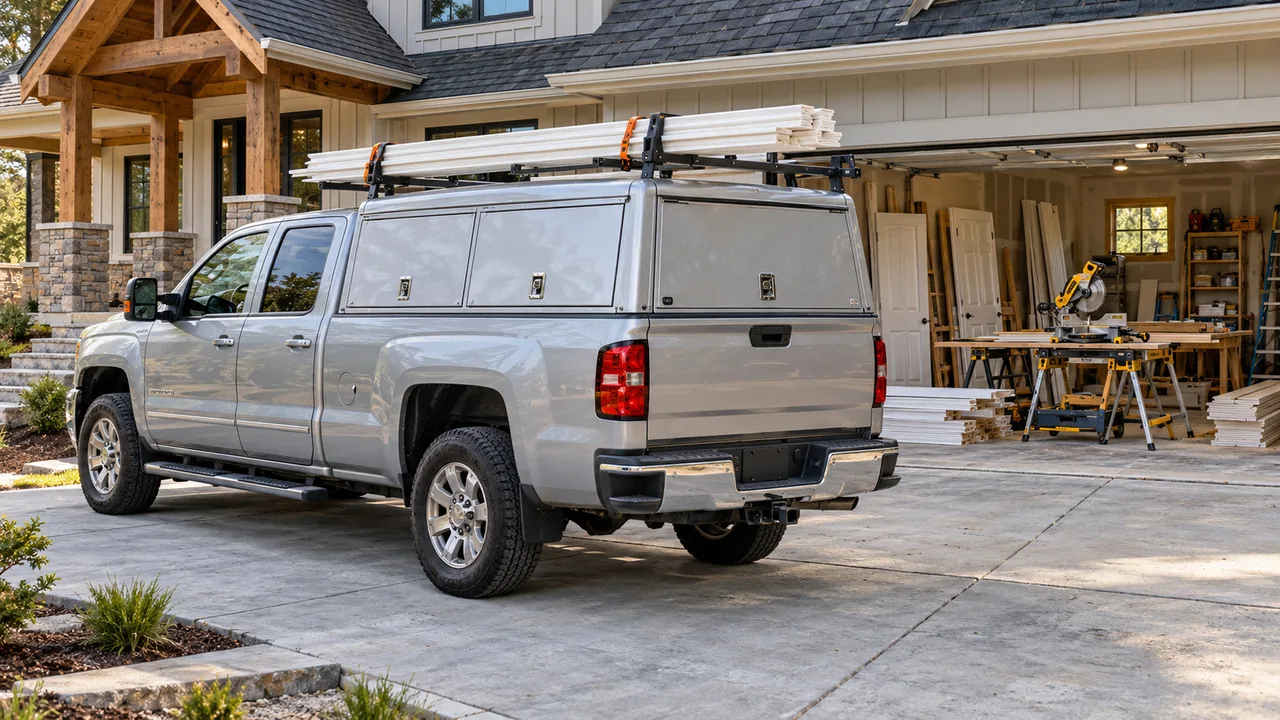
Most carpenters work out of a full-size pickup, often a three-quarter-ton crew cab with an overhead rack for ladders and long stock and a cross-bed toolbox behind the cab. Trim and finish carpenters haul sixteen-foot casing and base on that rack; deck builders haul composite boards and joists; door and window installers carry the units themselves, strapped upright in the bed. Some carpenters move up to a utility body for lockable compartments, which keeps nailers and saws out of sight but adds value the policy needs to know about. Insurance for contractor pickups covers how those trucks are rated.
The trailer is often the real workshop. A six-by-twelve enclosed trailer holds the miter saw station, table saw, compressor and hose reels, and some carpenters leave it at the same remodel for weeks. Others run an open utility trailer for deck lumber, scrap and dump runs. Either way, the trailer adds length and stopping distance, and it turns a tight residential driveway into a backing exercise.
Where the truck sleeps matters. Many carpenters park at home, with the trailer on the street or in the side yard, because there is no shop. That garaging address often drives much of the rate, and it's also where theft tends to happen: In the CHP's 2025 theft figures, older Chevrolet Silverados topped the personal-truck list for the fourth year in a row. A locked hitch, a wheel lock on the trailer and a camera over the driveway are simple steps carriers like to hear about.
Official sources
Liability comes first, and for carpenters the claims are often about what's on the truck rather than the truck itself. A length of trim or a sheet of plywood that lifts off the rack on the freeway, a trailer that fishtails in a crosswind, a misjudged reverse into a client's garage door: Each can turn into a claim against your auto liability. Most general contractors who hire carpentry subs want a $1 million combined single limit on the certificate. Read how auto liability limits are set.
Physical damage usually covers the pickup, the rack and the permanently mounted toolbox, plus the trailer if it's listed with a value. Trailer coverage on your auto policy tends to work as intended when the enclosed trailer has its own line, rather than being assumed to ride along with the truck.
For a sole owner who does most of the driving, uninsured motorist coverage deserves a look. If a driver with no insurance runs a light and hits your truck, uninsured motorist coverage for your work truck can pay for your own injuries, which matters for an owner who doesn't carry workers' comp on themselves.
For most carpenters, the limit decision gets made by the general contractors you work for. Their subcontracts usually set auto at a $1 million combined single limit, often with your auto policy naming the GC as additional insured. If your work is direct to homeowners or for small remodelers who don't specify a limit, you can look at $300,000, $500,000 or $750,000. Pull your three largest subcontracts before you choose, so you don't have to raise the limit mid-term to win a job.
One clause does come up for small carpentry accounts: A GC may ask that your auto policy cover any auto rather than only the listed trucks. That wording is generally meant to reach the borrowed or newly bought pickup that hasn't been added yet, and some carriers can write it for a one- or two-truck shop if you ask at the start. Some GCs also accept owned, hired and non-owned autos by exception, so check with the GC. Get the requirement in writing before the policy is bound, because adding it mid-term can be harder than starting with it.
A pickup with a rack and a small trailer is usually a long way from needing a Motor Carrier Permit, and filings rarely come up for a carpentry business. If you buy a heavier truck to pull a larger trailer, check California's truck insurance requirements before it goes to work.
Carpenters coming off a personal policy often have no commercial loss runs, and that's usually fine. Carriers typically look at your personal driving history, how long you've worked in the trade and how the truck is used. Simple controls help too: What underwriters often credit in a safety program can apply even to a one-truck shop with a dashcam.
If you've had a claim on a personal policy during a work trip, mention it at the start. The underwriter is likely to see it on the report anyway, and a short account of what happened and what you changed reads far better than a surprise halfway through the quote.
Most carpentry accounts we quote run one truck, sometimes two, and the owner is the main driver. That account is usually rated on the owner's record, the garaging ZIP and the trailer. A second pickup for a lead carpenter is typically an endorsement, not a new policy. If a family car gets used for estimates and supply runs now and then, tell us; depending on how often it happens, non-owned coverage or a listing on the policy may be the right answer.
At five to ten units you're usually a finish or trim company running crews for production builders or remodelers, each crew lead with a pickup and a shared trailer or two. Carriers tend to start asking who's assigned to which truck and whether crew leads may take them home. Small fleet insurance explains how that size gets rated.
Eleven to fifty trucks usually means a carpentry contractor with a yard, a dispatcher and crews spread across several subdivisions or commercial interiors jobs. Underwriters generally want hiring standards in writing, MVRs pulled every year and a clear line between company trucks and crew members' own vehicles used on the job. Growth midyear is handled by endorsement; tell us before the new truck carries its first load of trim.
Plenty of carpenters start with the pickup they already own, titled in their own name and insured on a personal policy. That can work until the truck becomes the business: a rack, a toolbox, a trailer hitch, a magnetic sign and jobs every weekday. Personal auto forms are priced for commuting and errands, and many limit or exclude coverage when the vehicle is used mainly to haul tools and materials for pay. The problem tends to show up at claim time, when an adjuster asks where you were headed.
A business auto policy can usually cover a personally titled truck for a sole proprietor, with the owner named as the insured. If you've formed an LLC or a corporation, the carrier will usually want to know whether the truck is titled to you or to the company, because that can change who the policy should name. Retitling isn't always required, but the policy generally needs to match the title. If the truck is financed, the loan agreement usually calls for the lender to be named as loss payee either way, with comprehensive and collision kept in force.
If you're unsure which form you have, look at your declarations page for the vehicle's listed use. Pleasure or commute on a truck that pulls a trailer to remodels every day is a mismatch worth fixing before renewal, not after a claim.
If it hauls tools and materials to paying jobs most days, many personal carriers won't treat that as covered use. Get the answer in writing or move the truck to a business auto policy.
A helper who takes your truck to the lumberyard is a driver. Most carriers want regular drivers listed, and an unlisted one with a poor record can complicate a claim.
Most carpenters' limits are set by the subcontracts they sign. Pull the insurance section from your three largest general contractors before choosing a limit or a deductible.
Trim or plywood that leaves the rack at highway speed can become a liability claim against your policy. Ratchet straps and a flag on long stock help head off one of the claims we see from carpenters.
Stake beds and boom trucks that stock board.
Commercial auto for drywall contractorsFinished cabinets riding in box trucks to installs.
Commercial auto for cabinet makersSprayer rigs and drop cloths in work vans.
Commercial auto for painting contractorsTiming depends on the carriers and your loss history.
Have ready: vehicle list with VINs, driver list, current declarations page, loss runs.
Next Level Experience. Insurance Done Right.
Fleet quotes for California businesses running up to 50 trucks and vans.