Bucket truckGVWR
- Weight
- Up to 33,000 lbs typical
- CDL
- Over 26,000 only
- Trades
- Tree service, electrical, roofing

Commercial auto for arborists and tree care companies running chip trucks, tow-behind chippers, bucket trucks and log trucks, including crews that work along the roadside. Quoted with top-rated national carriers.
Quick answer
Tree care companies usually need one commercial auto policy listing each chip truck, bucket truck and chipper by VIN, with the aerial device valued as part of the truck. Injury or damage from the tree work itself and from operating a bucket while it's working generally belongs to general liability. Chip-truck and bucket-truck quotes from us are built on a $1 million combined single limit.
Commercial Auto + Fleet Insurance
CaliforniaUp to 50 VehiclesWe’re here to help.
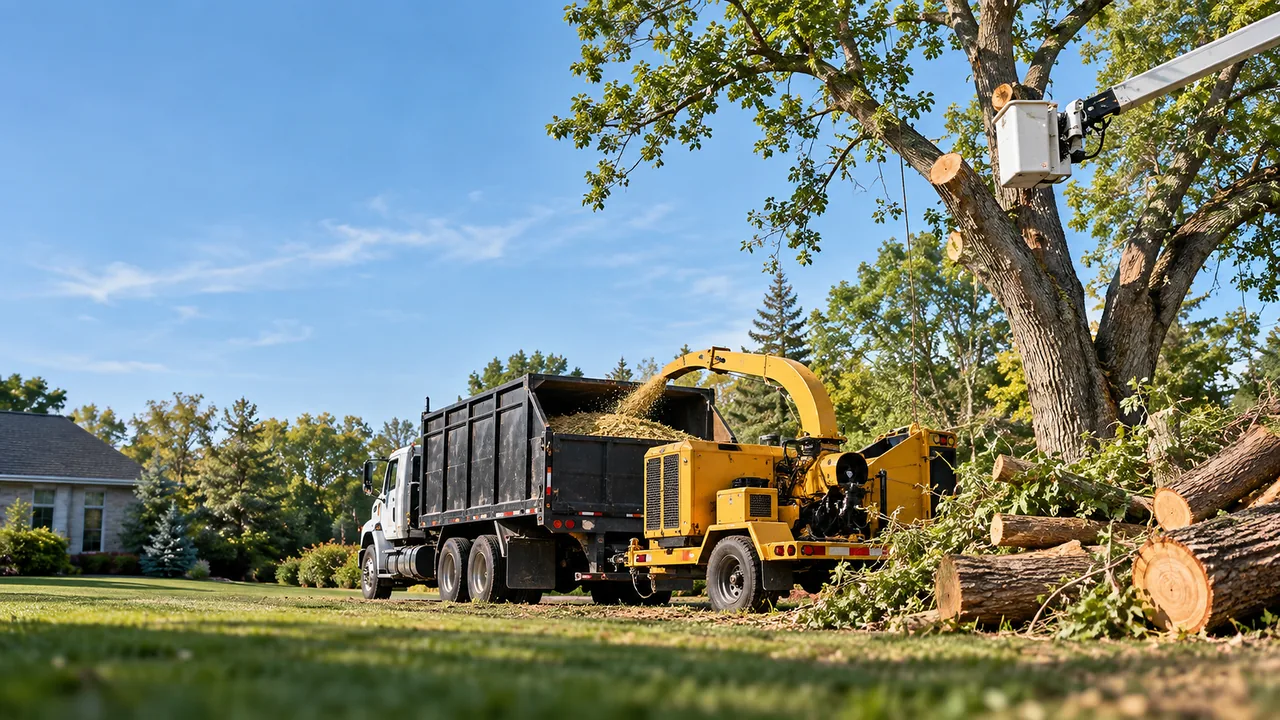
The center of a tree crew is the chip truck: a medium-duty chassis with an enclosed, high-sided chip box that dumps, often with a crew cab so the whole team rides together. A tow-behind brush chipper rides on the back, and the crew feeds brush into it at the curb so chips blow straight into the box. Removal crews add a stump grinder on a trailer, a compact track loader for moving rounds and on bigger jobs a knuckle-boom log truck or a crane. A log truck's loader typically follows the same split as a bucket: Hauling the wood falls to auto, while swinging rounds onto the bed with the boom does not.
Bucket trucks handle pruning and the work over roofs and wires. Forestry-body aerial lifts are common, many bought used from utilities, and line-clearance crews run insulated booms that are tested on a schedule. Pickups carry climbers, estimators and the plant health care sprayer. Our bucket truck insurance page covers aerial trucks in more detail, and California commercial truck insurance covers the rest of the heavy fleet.
Weight often puts this trade right at the commercial-license line. Chip trucks tend to be built either just under 26,001 lbs GVWR, so crew members without a commercial license can generally drive them, or well above it for bigger loads, and the chipper behind adds to the combination. Know the rating on every chassis and chipper before you hire a driver for it. Diesel chip trucks and older ex-utility buckets also generally fall under CARB's truck rules, which the California truck requirements page summarizes.
Official sources
On the road, this is heavy-truck liability. A loaded chip truck towing a chipper needs room to stop, swings wide on residential corners and works neighborhoods with cars parked on both sides. The claims tend to follow that pattern: clipped mirrors and fenders, low limbs or service drops snagged by the box, a chipper backed down a driveway into a gate and chips thrown from an uncovered box onto the car behind. Liability on our tree-service quotes starts from a $1 million combined single limit.
Physical damage needs honest values. A used forestry bucket can be worth more for its aerial device than for its chassis, and chippers are high-value trailers that can disappear from unfenced lots. Schedule every unit, including each chipper and stump grinder trailer, at what it would actually cost to replace; commercial truck physical damage insurance explains how carriers set those values.
Uninsured motorist coverage can protect the people riding in your trucks when an at-fault driver carries too little insurance or none, which matters for crews that spend the day parked on busy streets. A crew member struck while working outside the truck is usually a workers' comp claim first. UM/UIM for company trucks explains the rest.
Most tree contracts start at a $1 million combined single limit. City and county street-tree contracts, school districts, HOAs and property managers commonly add themselves as additional insured and ask for a waiver of subrogation, and utility vegetation-management work usually wants more total liability than an auto policy carries alone. That higher layer typically sits on a separately arranged umbrella above the auto. Line-clearance contracts also tend to ask for proof of training and safety programs alongside the certificate, so keep both current before bid season. Trimming near energized overhead lines generally brings in Cal/OSHA's line clearance tree trimming rules, and their approach distances vary with whether the person aloft is a qualified line clearance tree trimmer.
A small residential pruning outfit may be able to use a lower limit of $300,000, $500,000 or $750,000. Once a bucket truck works near wires or a crew sets up on a public street, most clients want the full million on the certificate, and many won't issue a permit or purchase order without it. Homeowners rarely ask for a certificate, but the HOA that manages the street trees in front of their homes usually does. Some clients check the contractor license as well; CSLB now licenses this work under its C-49 tree and palm classification, whose CSLB description includes planting, pruning, stump grinding, guying and removal.
Filings come up more here than in most outdoor trades. Chip trucks and bucket trucks can need a Motor Carrier Permit depending on weight, and units rated at 26,001 lbs or more generally put commercial-license rules, including drug and alcohol testing, on your drivers. The MC 65 M filing page explains the permit side.
Official sources
Ex-utility trucks usually get a closer look. A bucket bought at auction may have a long working life behind it, so many underwriters ask about inspection records, dielectric testing on insulated booms and who maintains the hydraulics. Owners who can produce those records and who run dashcams in their chip trucks can give the carrier reasons to credit the account; see how dashcams and telematics can help protect a fleet. A simple folder per truck, holding inspection dates, boom tests, brake work and the names of the people who drive it, tends to move a tree account through underwriting more smoothly. Cal/OSHA's tree work orders generally call for a qualified tree worker directing each job, documented training before a new hand works without oversight and a check of equipment before daily use, so those records can answer an underwriter's training questions too.
Official sources
Many tree companies start with a pickup, a chipper and a dump, or a single chip truck driven by the owner-climber. Carriers usually quote that like a small business auto account, but the chipper and a stump grinder trailer should be on the schedule from the start, and an owner who climbs should expect to be asked who drives when the owner is up the tree. Coverage for a one- to four-truck operation explains how a first policy is built.
At five to ten units, usually two or three crews with a bucket truck each, chip trucks, chippers and a log truck, the carrier typically sees a fleet of heavy trucks. The driver list often becomes the main rating question: commercial licenses, ages, MVRs and how new hires are trained before they take a loaded chip truck out. A groundsman moving up to driver should get supervised time behind the wheel of a loaded truck, chipper attached, before taking one out alone. Insurance for a small tree fleet covers that stage.
Between eleven and fifty, tree companies tend to hold municipal and utility contracts, run crews in several counties and handle storm work that surges after winter weather. Underwriters generally want to see how you supervise crews you can't watch, how you manage long storm shifts and whether loss trends are moving the right way. Insurance for an established fleet goes into the larger end.
Tree crews spend much of the day on the shoulder or in a traffic lane, with the chip truck and chipper parked where the work is. That's often when a parked truck gets hit, a passing car takes a falling branch or chips blow across the lane. Parking the truck upstream of the crew as a shield, with lights on and cones set far enough back for drivers to react, helps protect people and keep claims simpler. A chipper parked on a curve or just past a hill crest is among the hardest setups for an approaching driver to see; move it or stretch the warning zone.
Paperwork matters on public streets. City and county encroachment permits often come with a traffic control plan, and a crew that follows it usually has a stronger defense when a driver claims the work zone wasn't marked. Photograph the setup before the first cut; it's quick and can answer the question an adjuster is likely to ask.
Who pays depends on what happened. A passing car that hits your parked chip truck is generally the other driver's liability first, with your physical damage and uninsured motorist coverage behind it. Debris thrown by a running chipper is usually a general liability matter, while chips blowing out of the box at highway speed tend to point to auto. Knowing the difference helps get the claim to the right carrier the first time.
On the road a chipper is generally treated as a trailer and can be scheduled for physical damage. Injury or damage while it's chipping is usually a general liability question.
Once a chip truck's rating reaches 26,001 lbs, the driver generally needs a commercial license. Read the door sticker before you hand a new hire the keys.
After big winter storms, crews often run long shifts, and owners may put whoever is available behind the wheel. Underwriters tend to look for a rule on who may drive, even in a rush.
Inspection and dielectric test records on ex-utility buckets show an underwriter the aerial device is maintained, which can help a truck-heavy account get quoted.
Timing depends on the carriers and your loss history.
Have ready: vehicle list with VINs, driver list, current declarations page, loss runs.
Next Level Experience. Insurance Done Right.
Fleet quotes for California businesses running up to 50 trucks and vans.