Work pickupGVWR
- Weight
- Up to 14,000 lbs typical
- CDL
- No
- Trades
- Every trade

Commercial auto for mobile welders and fabrication shops whose rigs carry a welder/generator, gas cylinders and leads to farms, plants and job sites. One rig or a crew of them, quoted with top-rated national carriers.
Quick answer
A California welding rig generally belongs on a commercial auto policy, not personal auto, even when it's one owner's truck. Schedule the truck with its welding bed and mounted machine at full value; the welding work and the loose tools typically sit on other policies. We put a $1 million combined single limit on welding-rig quotes to start.
Commercial Auto + Fleet Insurance
CaliforniaUp to 50 VehiclesWe’re here to help.
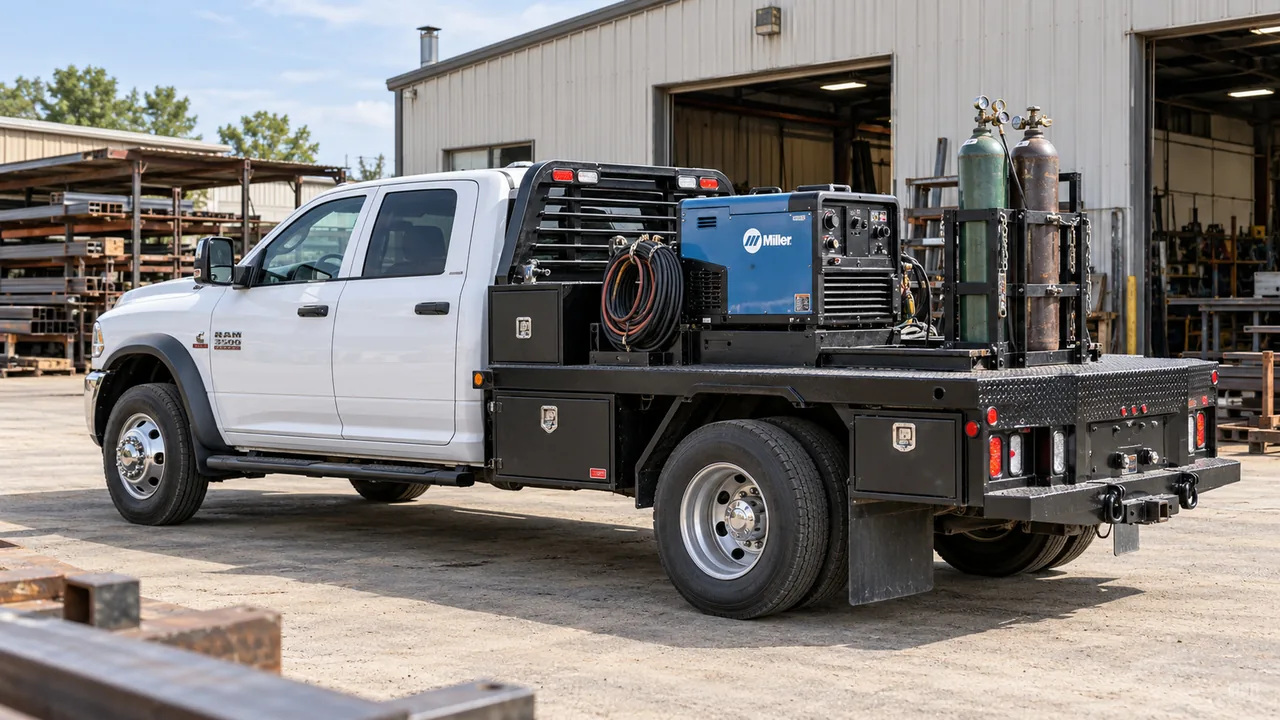
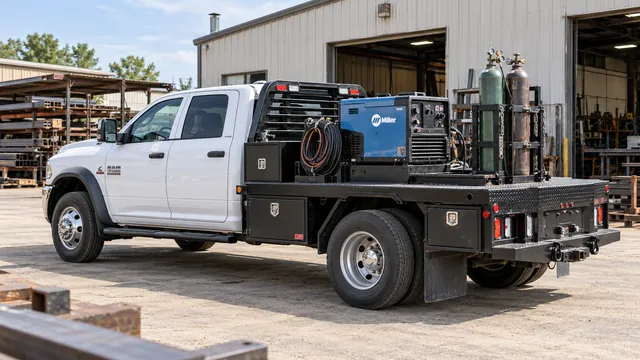
A working rig starts as a 3/4-ton or 1-ton pickup, very often a dually, with the factory bed pulled and a steel welding bed bolted on: a flat deck with side boxes, a headache rack, a vise post and a rack for bottles. The engine-driven welder/generator sits behind the cab, leads run to reels, and oxygen and acetylene cylinders ride upright in the rack beside an argon or mix bottle for wire and TIG work. Some shops build the same package on a utility body so every tool has a locked compartment, and a few pull a trailer-mounted machine or a material trailer for pipe and plate.
All of that is heavy. The machine, full bottles, rod, a grinder kit and a load of steel can push a 1-ton near its GVWR, which shows up in braking and tire wear long before it matters for licensing. Most rigs stay under 26,001 lbs and generally need no commercial license; a shop's delivery flatbed or a truck dragging a loaded material trailer may not. A rig that runs heavy every day also wears through springs and brake pads faster, and many underwriters like hearing that someone checks them on a schedule.
Mileage depends on the work. Plant and pipeline hands drive long distances to refineries, tank farms and compressor stations before sunrise; farm and ranch welders cover dirt roads across Kern, Tulare and Stanislaus counties; structural and ornamental crews fight for parking on city job sites. Radius, garaging and road type can rate differently for each pattern, so describe yours plainly. Commercial pickup truck insurance covers the base truck.
Official sources
Liability is usually the line contracts check first. Refineries, utilities, general contractors and plant owners usually want a certificate showing a $1 million combined single limit before a rig is waved through the gate. The driving behind that certificate is real exposure: early starts, long drives home after a shutdown shift and a loaded rig that needs more room to stop than the pickup it used to be. Our California commercial auto insurance hub explains how a business policy is assembled around it.
Physical damage is where welders often get surprised. The welding bed and boxes are generally treated as part of the truck. A welder/generator bolted to the deck can often be covered with the truck when its value is declared on the schedule, though some carriers would rather put the machine on an equipment policy, and portable gear usually doesn't ride on the auto form. Settle which way your carrier handles it before the machine walks off a motel lot, not after; physical damage coverage for trucks explains declared values.
Compressed gas can change the claim. A rear-end collision or rollover with full cylinders in the rack can shear a valve or feed a fire, which is why many underwriters ask how bottles are chained, capped and kept upright. Cal/OSHA's cylinder rule points the same way: It generally calls for a cylinder carried on a truck to be fastened so it can't tip, fall or roll, and for one built for a valve cap to keep it on whenever it isn't hooked up for use. Whether a given load of cylinders reaches hazmat quantities is a matter for the transport rules, not the insurance policy, and California's truck insurance requirements point to where those lines sit.
Official sources
We build from a $1 million combined single limit. A welder doing farm repairs and private jobs can sometimes carry $300,000, $500,000 or $750,000 instead, since those customers seldom ask for a certificate, but the first plant, refinery or contractor job usually brings the limit back up. Raising a limit mid-term is generally an endorsement request, so starting lower needn't lock you out of bigger work.
Refinery, utility and large industrial owners commonly ask contractors for more total liability than one auto policy typically carries, along with additional insured status, a waiver of subrogation and primary, noncontributory wording. The extra usually comes from an umbrella over the auto, general liability and employer's liability policies, and the umbrella carrier tends to set the auto limit it wants underneath. Primary wording generally means your auto policy responds ahead of the owner's own insurance when your rig is involved in a crash on their property; many plant contracts treat it as standard, so have us request it from the carrier when the policy is written rather than in the parking lot on the first morning of a shutdown.
Filings depend on the truck. A 3/4-ton rig and a 1-ton dually with a steel bed can land on different sides of the Motor Carrier Permit line because of how each is rated and classed; the MCP 65 insurance filing page explains the DMV filing if yours needs one.
Underwriters often read the type of work as a clue to the driving: A farm welder's dirt-road miles and a plant welder's pre-dawn freeway commute tend to produce different claims, so describe the mix honestly. CSLB licenses welding contractors under its C-60 classification, which CSLB describes as joining and fabricating metal with gas or electric heat; if you hold it, put the license number on the application. Theft is the loss welders bring up most. A rig at a motel near a shutdown or left overnight in a laydown yard can be a target for anyone who wants a welder or a set of bottles. A cable lock on the machine, a locking hitch, lit parking and bottles stored off the truck can all help, and our page on fleet safety and claims defense covers the controls underwriters weigh beyond that.
Official sources
Most welding businesses begin as one rig, owned by the person holding the stinger. That truck is often titled personally and used on weekends too, and it generally still needs a commercial policy once it's working for pay, because personal auto commonly excludes or limits that use. Small business auto insurance shows how carriers quote one truck.
A fabrication shop with five to ten rigs, a flatbed for deliveries and a few shop pickups is usually a small fleet to the carrier. Rating tends to move from the owner's record to the crew's: who drives, how experienced they are and what the shop does after an accident. Shops this size often hire their first young welders out of a trade program, and a written rule on when a new hand may drive a company rig is worth having before the underwriter asks. Insurance for a fleet of 5 to 10 trucks goes into what changes.
At eleven to fifty units, usually a contractor with crews on shutdowns, pipeline spreads and plant maintenance at once, loss runs and the safety program largely set the price. Rigs that follow projects around the state should be scheduled where they actually park, which shifts as jobs open and close, so tell us when a crew relocates for months. Crews driving home at the end of a long hitch can be a fatigue problem, and a stated choice between lodging and driving home often earns attention.
Welding contractors regularly bring in rig welders: independent hands who arrive in their own trucks with their own machines. Those trucks generally belong on the rig welder's own commercial auto policy, and your subcontract should say so in writing. Collect a certificate before the first shift, check that the named insured matches the truck's owner and keep it on file for the life of the job. Look at the limit too; a hand carrying a thin limit can leave more of a serious claim looking for your policy.
If a rig welder crashes on the way to your job and the injured driver names your company as well, hired and non-owned auto coverage on your policy can defend you. It usually sits behind the welder's own insurance, and it typically won't pay to repair their truck. If a hand drives one of your company rigs instead, they're generally treated as your driver: Add them to the list and run their MVR like anyone else's. Hired and non-owned coverage explains the details.
How you pay those hands matters too. Someone treated as an employee but paid as a contractor can change who an underwriter counts as a driver on your account and how your workers' comp carrier reads the payroll at audit. Settle the arrangement before the shutdown starts, not after a claim forces the question.
It can be, if the machine is declared on the vehicle schedule or written on an equipment policy. Find out which before your next out-of-town job.
Cylinders on a parked truck can invite theft and add fuel to a truck fire. Many underwriters ask about it by name.
Plant turnarounds often put welders on long shifts followed by long drives. We tell underwriters how you handle lodging and fatigue on extended jobs.
In a rear-end collision, loose steel and unsecured cylinders can injure people in the other car. Chained bottles and strapped material can help keep it a fender claim.
Ladder-rack vans on short in-town routes.
Commercial auto for alarm and securityTiming depends on the carriers and your loss history.
Have ready: vehicle list with VINs, driver list, current declarations page, loss runs.
Next Level Experience. Insurance Done Right.
Fleet quotes for California businesses running up to 50 trucks and vans.