FlatbedGVWR
- Weight
- 10,001–33,000 lbs typical
- CDL
- Over 26,000 only
- Trades
- Framers, drywall, fence, roofing

Commercial auto for roofing companies that move bundles and tile up to the roof and haul the tear-off away: flatbeds, conveyor and boom trucks, dump trailers and crew pickups. Up to 50 vehicles, placed with top-rated national carriers.
Quick answer
Roofing contractors usually need every flatbed, boom truck and crew pickup on one commercial auto policy, with each dump trailer scheduled as well. Underwriters tend to ask about load weight, tarped debris and who runs the boom. Roofing quotes start at the $1 million combined single limit builders usually ask for, and boom or conveyor work at the house is often a general liability matter.
Commercial Auto + Fleet Insurance
CaliforniaUp to 50 VehiclesWe’re here to help.
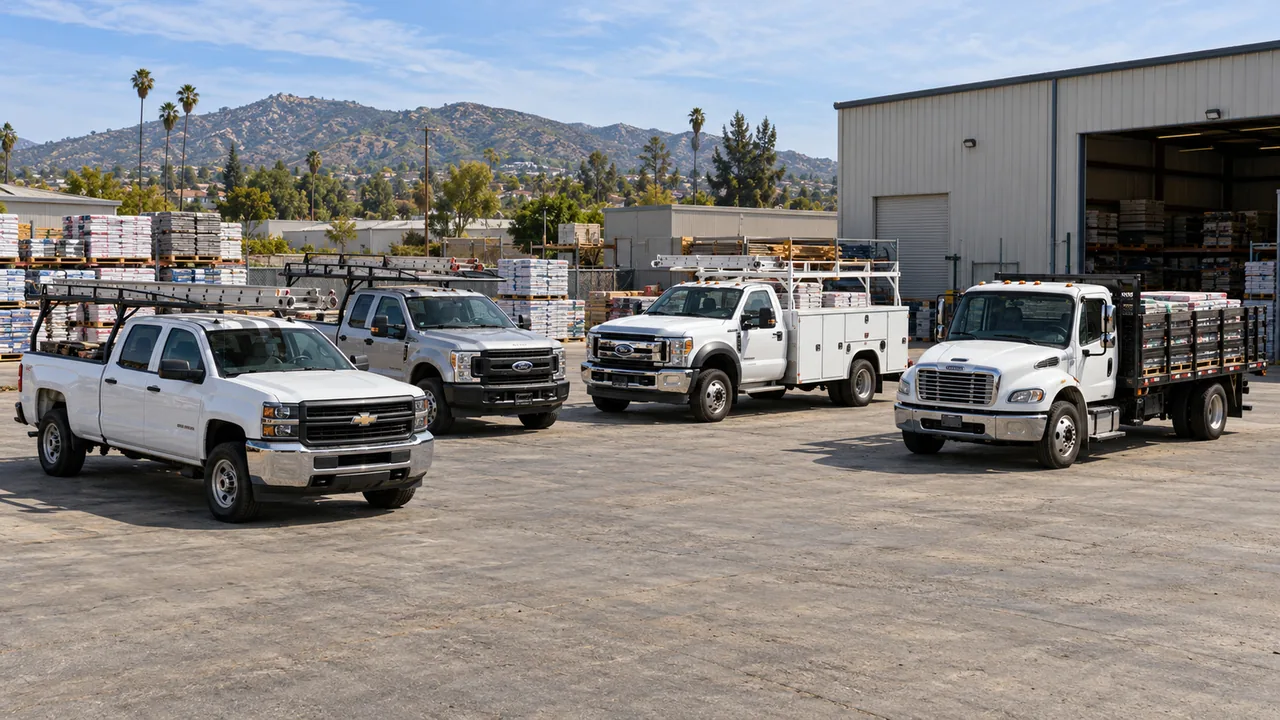
A roofing company's fleet follows the job from tear-off to final cleanup. Crew-cab pickups bring the roofers, their tear-off shovels and harnesses to the house. A pickup or stake bed tows a dump trailer that hauls the old shingles, felt and broken tile to the transfer station. Flatbeds and stake beds carry underlayment, flashing, vents and bundles when the supplier isn't delivering, and larger contractors run their own conveyor or boom truck to land material on the roof instead of waiting for the supplier's rooftop drop. Stake bed truck insurance, insurance for work trailers and boom truck insurance each have their own page.
Most of what CSLB's C-39 Roofing classification names, from felt and fiberglass fabric to metal roofing, wood shakes, tile and slate, rides to the job on these trucks at some point. These trucks often work close to their ratings. Concrete and clay tile, wet tear-off and full pallets of bundles get heavy fast, and a loaded dump trailer behind a 1-ton pickup can push the combination toward the point where a commercial license comes into play; California's truck insurance requirements explain where those lines fall. Most single trucks in the trade still sit under 26,001 lbs GVWR, but boom trucks and heavier stake beds often land in Class 4–6 (14,001 to 26,000 lbs), and carriers tend to rate them very differently from a crew pickup.
Debris is the road claim roofers see that most trades rarely do. An untarped dump trailer on the freeway can shed shingles, felt and nails across several lanes, and every cracked windshield and flat tire behind it can come back as a liability claim against your policy. Straps that loosen on a long haul, a bundle sliding off a flatbed on an on-ramp, a tile pallet that shifts in a turn: Underwriters recognize each of these from roofing loss runs.
Official sources
Auto liability carries most of the weight in roofing, because the trucks are heavy and the loads can come loose. A loaded stake bed needs far more room to stop than the pickup towing the dump trailer, and a boom truck turning into a cul-de-sac can take out a mailbox, a parked car or a strip of a neighbor's landscaping. That's why a $1 million combined single limit is our opening number for roofers: Builders, general contractors and commercial property owners usually want it on file before a crew climbs a ladder. Our page on commercial auto liability for contractors explains how the limit is built.
Physical damage on a boom or conveyor truck should reflect the truck with its unit installed, not the bare chassis, or a total loss may pay a fraction of what the replacement costs. Dump trailers usually need their own line on the schedule with a value; a trailer left off the list may carry liability while it's hitched but nothing for its own damage. Comprehensive and collision for work trucks walks through the options.
Tear-off crews usually ride together in a crew cab, and an estimator or foreman often drives a personal pickup out to measure a roof or check on a job. Hired and non-owned coverage can protect the company on those personal-vehicle trips and when a rented flatbed fills in while your own is in the body shop.
Builders and general contractors who hire a roofer usually put a $1 million combined single limit in the subcontract, along with additional insured status, primary and noncontributory wording and a waiver of subrogation. Reroof work sold straight to homeowners rarely comes with that paperwork, and a $300,000, $500,000 or $750,000 limit can fit when no contract asks for more. Production roofers working new subdivisions should expect the builder's agreement to set the number. Commercial reroofs on occupied buildings can add one more request: the owner, the property manager and sometimes the lender all named on the certificate. Read the insurance exhibit for names, not just numbers.
Heavier units can bring filings. A stake bed or boom truck hauling your own materials may need a California Motor Carrier Permit, and the DMV generally won't issue the permit until the carrier files proof of insurance. Our guide to the MC 65 M filing sets out which trucks typically need it and how the filing works.
One more line to draw clearly: Hauling material for another roofer or a supplier is generally treated as for-hire trucking, which calls for a different kind of policy and isn't something we place. Moving your own tear-off and your own materials is what a roofing auto policy is written for.
Roofing loss runs are often read for frequency as much as size. A string of small windshield and debris claims can worry an underwriter as much as one large crash, because it says something about how loads are handled. A tarping rule, a pre-trip check on every trailer and cameras on the trucks that tow them help answer that worry; how dashcams and telematics can help protect a fleet covers what those controls can do when a claim is disputed.
A one-truck roofer is often a pickup and a dump trailer with the owner at the wheel, written as a small commercial auto insurance in California account. Make sure the trailer is on the policy from the first day; on a solo roofer's application, it's often the missing piece.
At five to ten units, most roofing companies have added a flatbed or two and maybe a boom truck, and drivers start rotating between them. A written rule on who drives what matters here: The boom truck shouldn't go out with a new hire behind the wheel just because the regular driver called in sick. Small fleet insurance explains how carriers rate that size.
From 11 to 50, the account is usually a production or commercial roofer with several crews, a yard and often its own conveyor trucks. Carriers tend to look closely at the yard, the maintenance records on boom units and the safety program. Rainy-season leak calls and storm work can put extra trucks on the road in a hurry, so plan additions before the rush; new units go on by endorsement once you have the VIN. Insurance for an established fleet goes deeper on the top of that range.
Roofing material weighs more than most people expect, and it's stacked high. A few pallets of concrete tile can bring a stake bed close to its rating, and an overloaded truck brakes poorly, wears out brakes and tires early and handles badly in a sudden lane change. That's why roofing underwriters often ask about the heaviest load rather than the typical one. Spread heavy loads across trips when you can, and keep the weight over the axles, not hanging behind them.
Tear-off runs are the other habit to manage. A dump trailer headed to the transfer station should be tarped every time, with the tarp tied so it can't peel back at speed. Officers watch for it: The CHP's enforcement manual directs proactive enforcement of load covers such as tarps on cargo headed to dump sites. Drivers should check the hitch, safety chains, breakaway cable, lights and trailer brakes at every hookup, because a trailer that separates on a downhill grade is the kind of claim that shapes a renewal. Sweep the street with a magnet before leaving, too; nails left at the curb are a nuisance the neighbors remember.
Rooftop delivery deserves a clear line as well. When the supplier's boom truck lands your bundles, its driver and its insurance are generally the ones answering for a dented car in the driveway. When your own conveyor truck does the same work, that exposure is usually yours, so the operator should be trained, the outriggers set on solid ground and the swing area kept clear of parked cars.
Official sources
Driving the truck is usually auto. Lifting bundles onto the roof is often treated as general liability, so check both policies before the boom goes up.
An unlisted trailer may have liability while it's hitched and nothing for its own damage. List every trailer with its year, VIN and value.
Several windshield claims from flying tear-off can weigh on a renewal like one large loss. Tarping every load is one of the simplest fixes available.
A conveyor or boom truck scheduled at its bare-truck value can leave the unit uninsured after a total loss. Schedule the truck as it's built.
The trucks that run the whole job, from pickups to dumps.
Commercial auto for general contractorsStake beds lifting board to the upper floors.
Commercial auto for drywall contractorsBox trucks delivering finished boxes to the job.
Commercial auto for cabinet makersVans carrying tile, plank and carpet rolls.
Commercial auto for flooring installersTiming depends on the carriers and your loss history.
Have ready: vehicle list with VINs, driver list, current declarations page, loss runs.
Next Level Experience. Insurance Done Right.
Fleet quotes for California businesses running up to 50 trucks and vans.