Service bodyGVWR
- Weight
- 10,001–19,500 lbs typical
- CDL
- No
- Trades
- Plumbing, HVAC, electrical, repair

Commercial auto for field mechanics and equipment repair shops running crane-body trucks, lube rigs and parts pickups across California. Tell us how many trucks you run, and we'll shop top-rated national carriers.
Quick answer
An equipment repair company usually needs one commercial auto policy that schedules every crane-body and service truck at its built-out value, allows for mechanics who keep trucks at home for call-outs and starts at a $1 million combined single limit. A customer's machine in your care generally falls outside the auto policy.
Commercial Auto + Fleet Insurance
CaliforniaUp to 50 VehiclesWe’re here to help.
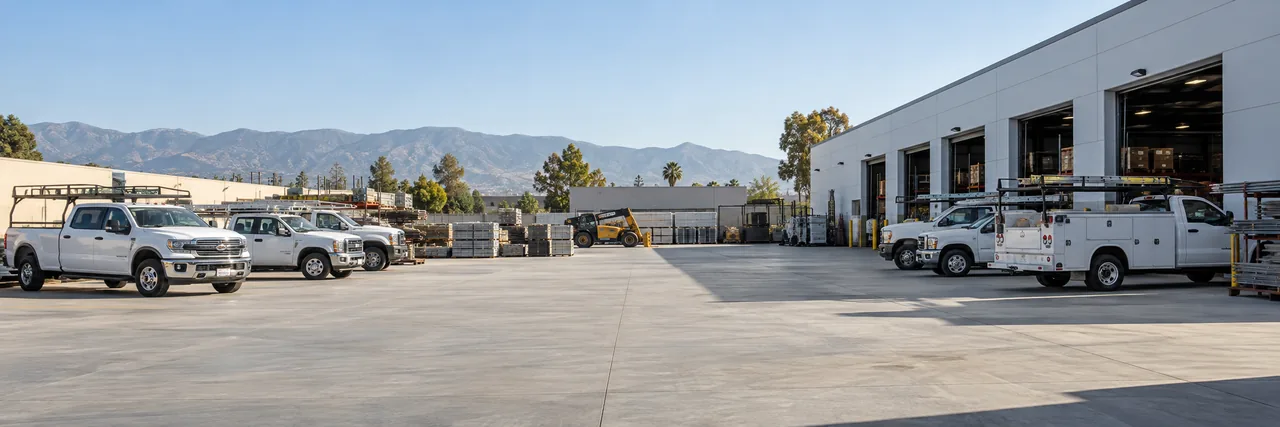
The working unit in this trade is the mechanic's truck: a Class 4 or 5 cab and chassis, usually a 550 or 5500 series, carrying a crane body. Compartments down both sides hold hand tools, impact guns and diagnostic gear; a telescopic crane sits on the rear corner; an air compressor and often a welder/generator ride under the deck; and many trucks add a lube skid with tanks for engine oil, hydraulic fluid and waste oil. Parts runners and estimators drive pickups, and shops that bring machines back to the yard keep an equipment trailer and a truck rated to pull it.
Most 550-series crane trucks stay under 26,001 lbs GVWR, so a mechanic with an ordinary license can generally drive one. A bigger crane on a medium-duty chassis can cross that line, and then the driver typically needs a commercial license, and the underwriter's questions get longer. Pull the GVWR off each door sticker for your vehicle list instead of going by model name; two trucks that look alike from the curb can carry very different ratings. Diesel crane trucks on the heavier chassis are also generally subject to CARB's Clean Truck Check emissions testing, and DMV can hold a registration until the truck passes.
Overnight parking is the other early question. Plenty of repair outfits send mechanics home in their trucks so they can roll straight to a dead loader at a quarry, a forklift at a distribution center or a tractor in a Fresno County orchard before the shop opens. A crane truck full of tools and fluids parked in a driveway often rates differently from one behind the shop fence, and most carriers want to know which you do. Our page on crane body truck insurance covers the body itself.
Official sources
Liability leads. A loaded crane truck is heavy, carries its weight high and often reaches a broken machine by haul road, farm lane or highway shoulder. The claims are rarely exotic: backing into a customer's pickup in a crowded equipment yard, catching a gate or carport with the crane or rear-ending traffic while hurrying to a down machine. Our repair-truck quotes take a $1 million combined single limit as the opening figure, the one quarries, rental houses, dealers and public fleets usually build into their agreements.
Physical damage should reflect the truck as built. The body, crane, compressor and lube skid can be worth more than the cab and chassis beneath them, and a truck scheduled at chassis value can leave a large gap after a rollover or fire. Keep the upfitter's invoice and schedule each unit at its replacement cost as equipped; comprehensive and collision for work trucks explains stated values and deductibles.
If you bring customers' machines back to the shop, the trailer belongs on the schedule, and the truck towing it should be rated for the load. Moving a machine as part of a repair ticket is ordinary in this trade; hauling equipment for people as a separate paid service usually counts as for-hire work, which most carriers underwrite as a different business, so tell us before you offer it. The rest of a business policy is laid out on our commercial auto insurance in California hub.
Official sources
For field repair work we start the conversation at a $1 million combined single limit. Lower limits of $300,000, $500,000 or $750,000 can fit a mechanic whose work is mostly private-owner and small-farm repair, where a certificate request rarely comes up. Dealer service agreements, aggregate and mining customers, equipment rental houses and city or county fleet contracts are a different story: They usually want the full million, the customer added as additional insured and a waiver of subrogation on the auto policy.
Get the contract's insurance page to us before renewal, not on the morning a gate guard turns a truck away. Dealer and rental-house agreements also tend to ask that your coverage be primary and noncontributory, so your policy generally answers first for a crash involving your truck on their lot; that's an endorsement the carrier has to approve, far easier to request at binding than to chase in the middle of a job. Some mine sites and large public fleets ask for more liability than one auto policy usually carries; that extra layer typically comes from a separately arranged umbrella over the auto policy.
Heavier crane trucks can bring filings with them. A unit rated at 26,001 lbs or more generally calls for a commercial-license driver, and trucks in the heavier classes can need a Motor Carrier Permit; the MC 65 M filing guide explains where that line falls, so read it before you spec a bigger chassis.
The boom question carries more weight than owners expect. Overpasses, parking structures, drive-through canopies and overhead wires all get hit by trucks that left a job with the crane not fully stowed, and an underwriter who has paid one of those claims tends to look for a stow alarm, a walkaround habit and a person accountable for both. Answer the fluids question precisely as well: An underwriter who reads lube truck on the schedule may picture a far larger tank operation than a skid with a few drums' worth of oil. The fleet safety measures underwriters often credit go further than the crane.
A one-truck mechanic, often someone who left a dealer's service department to work independently, is usually quoted on the owner's record, the truck's built value and the radius, and carriers often ask how long the owner has worked in the field. If the truck is titled personally but works for paying customers, it generally still belongs on a commercial policy; our guide to business auto for one to four trucks walks through that first policy.
Somewhere around five to ten trucks, carriers often start treating the account as a fleet. Many then ask for a written rule on who may drive, a yearly MVR check and every unit on one renewal date. This is usually also when a shop adds its first heavier crane truck or a dedicated lube truck, and those units can move the price more than a handful of extra pickups. Small fleet insurance covers what changes at that size.
From eleven to fifty, typically a regional outfit with mechanics stationed in different counties, loss trends and training records tend to drive most of the price. Garaging spread from the Central Valley to the Inland Empire is generally rated ZIP by ZIP, so keep the vehicle list current as mechanics move; an accurate list helps keep a premium audit uneventful.
Repair owners ask us this often: If the crane drops a final drive onto a customer's pickup, which policy pays? Under most business auto forms, injury or damage caused by operating a crane, compressor or welder mounted on the truck is excluded from auto liability, and general liability is expected to respond instead. Driving to the job, parking the truck and backing it into position generally stay with the auto policy. The same split usually runs through the rest of the deck: An air hose that whips loose and hurts a bystander while the compressor is running points to general liability, while the truck rolling off its chocks points to auto.
That handoff tends to hold up when both policies are in place and fit each other. The general liability policy shouldn't carry its own exclusion for truck-mounted equipment, the named insureds on both should match, and the limits should meet what your contracts require. Ask whoever writes your general liability coverage to confirm it picks up crane operations; a gap between the two policies is often where repair claims get argued.
Outriggers deserve their own line. A crane set up on a soft shoulder or a customer's new concrete can crack a slab or sink a pad, and that damage usually lands on general liability as well. Cribbing under the outrigger pads and a photo of the setup area before the lift cost little, and they can help when a customer blames the crack on you weeks later.
For physical damage, usually yes, when its value is included in the truck's schedule. Injury or damage caused by operating it tends to fall to general liability.
A crane body, compressor and lube skid can be worth more than the cab and chassis. Insure the built value, or a total loss may pay for little more than a bare truck.
Ag repair outfits in the Valley often run longer days and longer miles from spring into fall. We tell the underwriter how you staff that stretch before the loss runs raise it.
Overpass and canopy strikes can be expensive repair-truck claims. An in-cab alarm and a pre-trip check can give a carrier something concrete to credit.
Light vans with ladders, mostly in town.
Commercial auto for alarm and securityTiming depends on the carriers and your loss history.
Have ready: vehicle list with VINs, driver list, current declarations page, loss runs.
Next Level Experience. Insurance Done Right.
Fleet quotes for California businesses running up to 50 trucks and vans.