Service bodyGVWR
- Weight
- 10,001–19,500 lbs typical
- CDL
- No
- Trades
- Plumbing, HVAC, electrical, repair

Coverage for plumbing shops whose service trucks, jetter rigs and take-home vans answer calls around the clock. One truck or up to 50 vehicles, with options from top-rated national carriers.
Quick answer
A California plumbing company usually needs one commercial auto policy covering every service truck, van and jetter trailer, with take-home vans listed at the addresses where they spend the night. Water damage from a job and the jetter's work in the line typically aren't auto claims. Plumbing quotes begin at a $1 million combined single limit.
Commercial Auto + Fleet Insurance
CaliforniaUp to 50 VehiclesWe’re here to help.
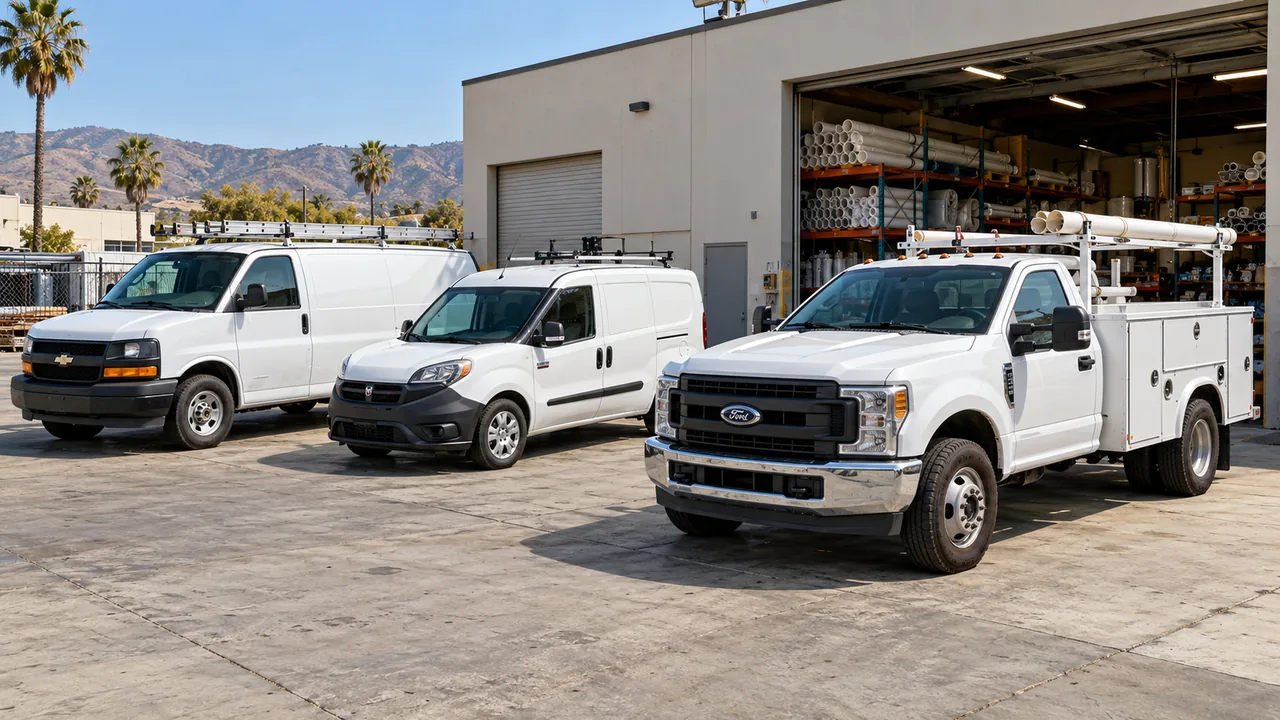
Plumbing fleets split into two kinds of vehicle. Service plumbers drive cargo vans or utility-body trucks stocked like a small supply house: fittings and valves in the bins, copper and PEX on the rack, a drain machine and inspection camera by the rear doors and a water heater or two strapped behind the bulkhead. The license is just as broad: CSLB's C-36 Plumbing classification runs from waste and gas piping to water heaters, backflow preventers and gas earthquake valves. Drain and sewer crews run jetter rigs, either a jetter mounted in a box or utility body or a trailer jetter towed behind a 3/4-ton pickup. See utility body truck insurance and Sprinter van insurance for the vehicles themselves.
The jetter is the unit underwriters often ask about first. It's heavy, it's often worth more than the truck pulling it, and it goes out at night for backed-up main lines and restaurant grease calls. A few large drain companies also run a combination jetter and vacuum truck, which can be heavy enough to need a commercial license. Any unit that heavy is also well past the 14,000-lb GVWR mark where CARB's Clean Truck Check generally begins for diesel trucks. Tell us about one of those up front, because some carriers that like light vans won't write it. Sewer replacement crews may also tow a mini-excavator or a pipe-bursting rig on a trailer to lateral jobs, which belongs on the vehicle list too.
Most plumbing vans go home with the plumber, because the tech answering a 2 a.m. slab leak can't stop at the shop first. Some shops also keep a single on-call van that moves to whoever has the rotation that week, which means its overnight address keeps changing. Explain how that works to the carrier rather than listing one driveway that's only right some of the time. The rotation also puts tired drivers on dark roads, and carriers tend to weigh that when they read a plumbing account.
Official sources
Like any commercial vehicle insurance in California, a plumbing policy is assembled from separate coverages. Plumbing crashes are mostly ordinary road crashes, but a service body loaded with cast iron, a water heater and full bins hits harder and stops longer than an empty pickup. Commercial auto liability insurance generally pays the other side's injuries and repairs and your defense if you're sued. A $1 million combined single limit is where a plumbing quote opens, because builders, property managers and restaurant groups with service agreements commonly write that number into their contracts.
Physical damage is meant for the trucks themselves. Shelving, bins, racks and a truck-mounted jetter can be counted in the vehicle's value, so give us the upfit and jetter cost when the truck is scheduled. Carriers differ on whether a mounted jetter rides with the vehicle or belongs on an equipment form, and it's worth asking before a loss. A trailer jetter generally needs its own line with its own value for a collision, a theft from the yard or a fire on the trailer to be covered. Physical damage coverage explains comprehensive and collision in more depth.
Plumbers borrow vehicles more often than owners think. An apprentice runs a fitting to the job in a personal car; a van goes in for brakes, and the plumber drives a rental for two days; a dispatcher picks up permits at city hall on the way in. Coverage for employees' own cars on company business can handle the company's liability on those trips.
Plumbing contracts come from builders, property management companies, school districts and restaurant chains, and most of them ask for proof of a $1 million combined single limit on auto. A residential service shop without those contracts can carry $300,000, $500,000 or $750,000 instead, as long as its customers accept the certificate. If you're bidding a new-construction phase or a service agreement with a large landlord, check the insurance exhibit before you settle on a limit.
Certificates can be a weekly chore in plumbing. Additional insured status, a waiver of subrogation and primary wording are usually endorsements on the auto policy. A blanket version of each, if the carrier offers it, saves a new endorsement every time a property manager sends a request. Ask for the blanket forms at binding. Restaurant groups and multi-site landlords sometimes want every serviced location listed as well; give us that list once, and we'll carry it forward at each renewal.
Whether a heavier jetter or jetter-vac truck needs a Motor Carrier Permit depends on its weight and use; the California Motor Carrier Permit insurance filing page walks through it.
Telematics is especially useful in plumbing because it can show the after-hours driving an underwriter worries about. A shop that watches speed and hard braking during on-call nights and can say what it does about a driver who keeps showing up in the report tends to have an easier renewal conversation. Fleet safety and claims defense explains how that data and dash camera footage can be used when a claim comes in.
A master plumber working alone out of one van usually has a simple application, with the owner's own driving record weighing more than anything else on it. If the van doubles as the family vehicle on weekends, say so; carriers would rather hear it at the start than find it in a claim file. Insurance for one to four work trucks explains that size.
A shop with five to ten trucks usually has an on-call rotation, a handful of service vans and one drain rig. Carriers generally read it as a fleet, and the take-home list becomes part of the application rather than a footnote. Fleet insurance for 5 to 10 vehicles covers how that's rated.
From 11 to 50, plumbing companies often split into service, drain and new-construction divisions, each with different vehicles and different hours. Present them separately: A construction pickup parked at one site all day is a different risk from a service van making six calls. Price at this size tends to rest on the trend in your loss runs and the driver program, and new trucks are added by endorsement as they arrive.
Emergency plumbing often happens when everyone else is asleep: a burst supply line, a flooded slab, a restaurant's main line backing up before Saturday service. The plumber driving to that call has often already worked a full day, and fatigue behind the wheel is where many nighttime crashes begin. A cap on consecutive on-call nights and a clear rule that a plumber may hand off a call when too tired to drive are simple policies that read well to an underwriter.
Urgency changes how people drive. A dispatcher who promises a customer an arrival time puts pressure on the plumber to make it, and that pressure shows up at yellow lights. Give dispatchers language that promises a callback rather than a clock, and the driver has one less reason to hurry. Road-facing cameras matter here too, because a nighttime intersection crash with no witnesses often comes down to whose story holds up.
Weather sets the volume. A cold snap that freezes exposed pipes in the foothills or a winter storm that overwhelms older sewer lines can put every on-call plumber on the road at once, in rain and darkness. Plan for those surges before they arrive, so you're not handing a van to a helper the carrier has never seen just to cover the calls.
Liability usually follows the truck while the trailer is hitched. Damage to the jetter itself generally requires the trailer to be scheduled with its value.
Night driving is part of how most plumbing accounts are rated. When it first shows up in a claim file, the next renewal can get harder.
Plumbers expect to take the van home, and shops use it to recruit. Written rules show the carrier a program rather than a perk.
A backup in a customer's building during jetting comes from the work. The auto policy is generally about the drive to the job, not what happens in the line.
Vans and service bodies, plus a bucket truck or two.
Commercial auto for electricalLadder-rack vans making short trips around town.
Commercial auto for alarm and securityCrane bodies and customers' equipment in the bed.
Commercial auto for equipment repairTiming depends on the carriers and your loss history.
Have ready: vehicle list with VINs, driver list, current declarations page, loss runs.
Next Level Experience. Insurance Done Right.
Fleet quotes for California businesses running up to 50 trucks and vans.