Service bodyGVWR
- Weight
- 10,001–19,500 lbs typical
- CDL
- No
- Trades
- Plumbing, HVAC, electrical, repair

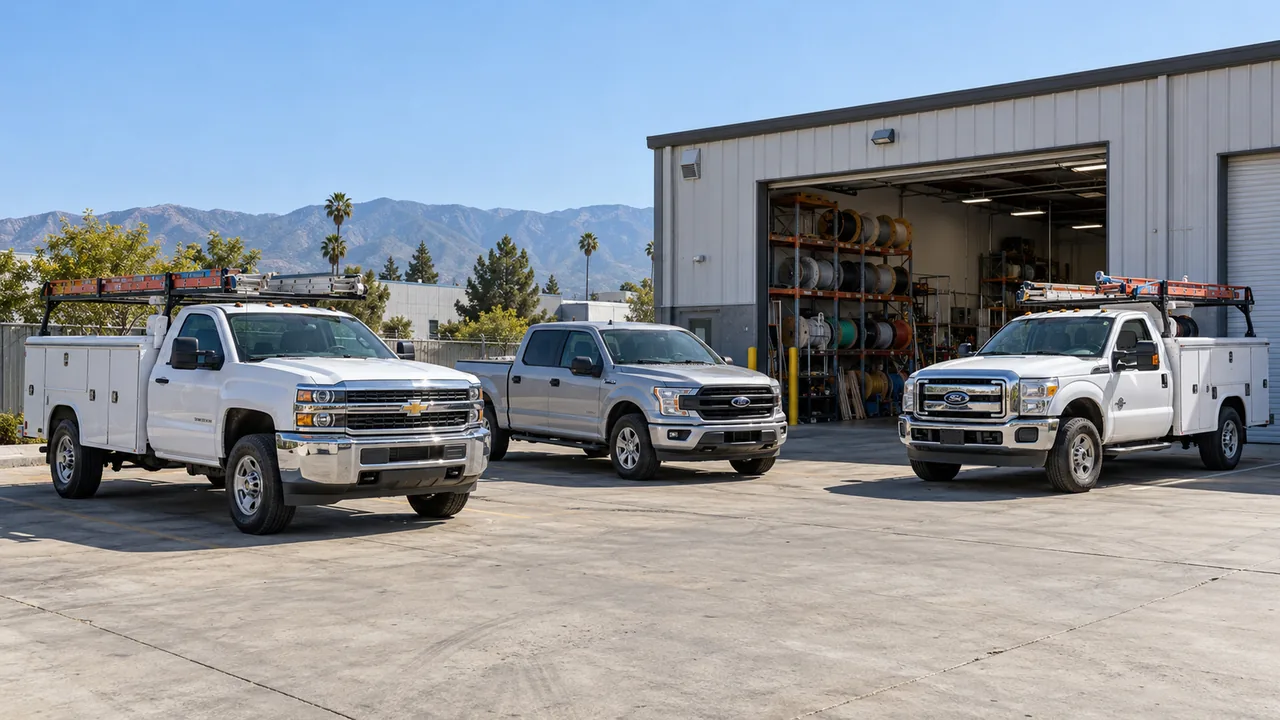
Utility-body trucks with side compartments, ladder racks and on some a crane at the back: the rolling shops of plumbers, electricians, mechanics and welders. Insured for one truck or fifty.
Quick answer
A service or utility body truck should go on a commercial auto policy at its full built-out value, not the bare chassis price. Most are two-axle trucks rated 10,001 to 19,500 lbs, so drivers generally don't need a CDL unless the truck tows a trailer rated over 10,000 lbs. A crane, welder or compressor mounted on the body is usually treated as equipment, covered outside the auto policy.
Commercial Auto + Fleet Insurance
CaliforniaUp to 50 VehiclesWe’re here to help.
Most service bodies are built on one-ton and Class 4 or 5 chassis: an F-350 or F-550, a Silverado 4500 or 5500, a Ram 5500 or a cab-over with a walk-in body. Ratings usually fall between about 10,000 and 19,500 lbs, which keeps most of them well under the 26,001-lb CDL line. A technician with a regular license can generally drive the truck.
Weight still matters inside that band. A mechanic's truck carrying a crane, a full welding bed or a large air compressor runs close to its GVWR every day, and a heavily loaded body brakes and corners differently from an empty one. Underwriters typically read the chassis class, then ask what's permanently mounted on the body.
Service trucks are one of several body types on our California commercial truck insurance hub. Vehicle Code 34601 generally reaches any two-axle truck rated over 10,000 lbs, so most service bodies need a Motor Carrier Permit even when they carry only the company's own parts and tools; our guide to California commercial truck insurance requirements sorts through the filings.
Official sources
A service truck behaves more like a shop on wheels than a delivery vehicle. It spends the day parked at customers' buildings and in job-site lots, makes short hops between calls and at night either goes home with the technician or sits in a yard full of other trucks. Underwriters picture that pattern: fewer highway miles than a box truck, far more time maneuvering in parking lots and a driver whose real job is the repair rather than the drive.
The claims tend to follow the pattern: parking-lot contact while swinging a wide body into a space, a compartment door left open and struck by passing traffic, a ladder that wasn't latched sliding off the rack and rear-end collisions when a tech glances at the next address on a phone. Distracted driving comes up in nearly every service-fleet conversation we have with an underwriter.
The other question is what the truck is worth as built. A body with compartments, a rack, drawers, an inverter and a crane can cost as much as the chassis under it, and that number shapes both the physical damage premium and how a total loss tends to be settled.
Service agreements with hospitals, school districts, cities and large property managers commonly name a $1 million combined single limit for auto, often with additional insured wording and a waiver of subrogation. We build service truck quotes around that figure. Where contracts allow, a residential service company can choose $750,000, generally the legal minimum for a service truck that needs a Motor Carrier Permit; the $300,000 and $500,000 options suit lighter vehicles that stay outside the permit.
Physical damage is where service bodies need the most care. Schedule the chassis and body together at replacement cost as equipped: utility body, compartments, ladder rack, drawers, inverter and any fixed shelving. A body moved from an old chassis to a new one needs its value carried over too. Deductible and valuation choices are laid out on our page about commercial truck physical damage insurance.
When a tech's truck is in the shop and the tech finishes the week in their own pickup, or a service manager runs parts in a personal car, hired and non-owned coverage is the coverage that can protect the business.
Official sources
Nine of the trades we write lean on utility bodies, and each one loads the compartments differently.
Hand tools, fasteners and trim stock kept in order and out of the rain.
Carpenter commercial auto insuranceLarger bodies for commercial rooftop and install work.
HVAC commercial auto insuranceCompartment trucks and jetter rigs that go home with techs.
Plumbing contractor commercial auto insuranceWire reels, conduit racks and panels in locked compartments.
Electrical contractor commercial auto insuranceCompartments set up for treatment products and spray rigs.
Pest control commercial auto insuranceMechanics' trucks with crane bodies, compressors and customers' parts.
Equipment repair commercial auto insuranceChemicals, pumps and filters riding in locked compartments.
Pool contractor commercial auto insuranceLocating, tooling and support trucks that follow the drill rig.
Directional boring contractor truck insuranceService bodies are generally rated on the same base as other trucks, but a few factors carry extra weight for this body type.
| Factor | What it means for a service body truck |
|---|---|
| Built-out value | Body, rack, drawers and inverter can equal the chassis in cost. A higher scheduled value raises the physical damage premium and helps keep a total-loss settlement realistic. |
| Mounted equipment | A crane, welder or compressor adds weight and changes how the truck handles, and underwriters usually ask about each one. |
| Take-home garaging | A truck parked in a technician's driveway is typically rated at that ZIP, not at your shop's address. |
| Calls per day | Short hops and frequent parking tend to add low-speed contact claims even when total miles stay modest. |
| Driver experience | New technicians driving a heavy, wide body for the first time often show up on loss runs; ride-alongs and a probation period help. |
| Phone use | A written hands-free rule backed by telematics speaks to the distracted-driving risk underwriters worry about. |
| Customer contract terms | Additional insured endorsements and waivers your customers require usually go on the policy and may move the price. |
Telematics that log hard braking and speeding can give an underwriter something concrete to credit. We explain how that data and dashcam footage get used on our page about fleet safety and claims defense.
A crane body is two risks sharing one chassis. On the road, the truck and the weight of the crane are generally auto exposures. Once the outriggers go down and the boom starts to lift, most carriers see the crane as working equipment: Damage to the crane itself belongs on an equipment policy, and injury or damage caused by a lift is often treated as general liability rather than auto.
Underwriters on both sides usually ask about crane capacity, who is allowed to operate it and how loads are rigged. Equipment repair companies add one more wrinkle: A customer's engine or gearbox riding in the bed is someone else's property in your care, which is a separate coverage question from both auto and the crane.
New service trucks rarely arrive finished. The chassis comes from the dealer, then often spends weeks at an upfitter getting the body, rack, drawers and wiring. Put the truck on the policy as soon as it's titled to you, even if it's still sitting at the upfitter, and send us the upfitter's invoice when the work is done so the value catches up.
If the body is financed separately from the chassis, the lender for each may want to be named on the policy. Getting both names on the certificate at the start can save a scramble when the truck is delivered.
Many service companies run utility bodies alongside cargo vans: trucks for the heavy or messy work, vans for lighter calls. A single policy usually handles both, but carriers rate the two bodies differently, and our cargo van insurance page covers the van side. Whichever bodies you run, write down who may take a truck home, whether personal errands are allowed and whether anyone else may drive it.
Once a service fleet passes 25 units, loss trends and the written safety program often start to set the price; fleet insurance for 26 to 50 vehicles walks through what carriers look for at that size.
Usually not. A California service body truck that goes home with a technician is rated at the ZIP where it spends the night, not at your shop's address, so list each truck's real overnight location.
When a utility body moves to a new chassis, owners often schedule the truck at the dealer's price alone. The body's value has to move with it, or a total-loss payout may cover only the cab and chassis.
Distracted driving comes up in nearly every service-fleet review we have with underwriters. A written hands-free rule, backed by telematics that log hard braking and speeding, can answer the question before it's asked.
Service agreements with hospitals, school districts and cities often require additional insured wording and a waiver of subrogation on the auto policy. Those endorsements are typically added to the policy and can affect the price.
Timing depends on the carriers and your loss history.
Have ready: vehicle list with VINs, driver list, current declarations page, loss runs.
Next Level Experience. Insurance Done Right.
Fleet quotes for California businesses running up to 50 trucks and vans.