Work pickupGVWR
- Weight
- Up to 14,000 lbs typical
- CDL
- No
- Trades
- Every trade

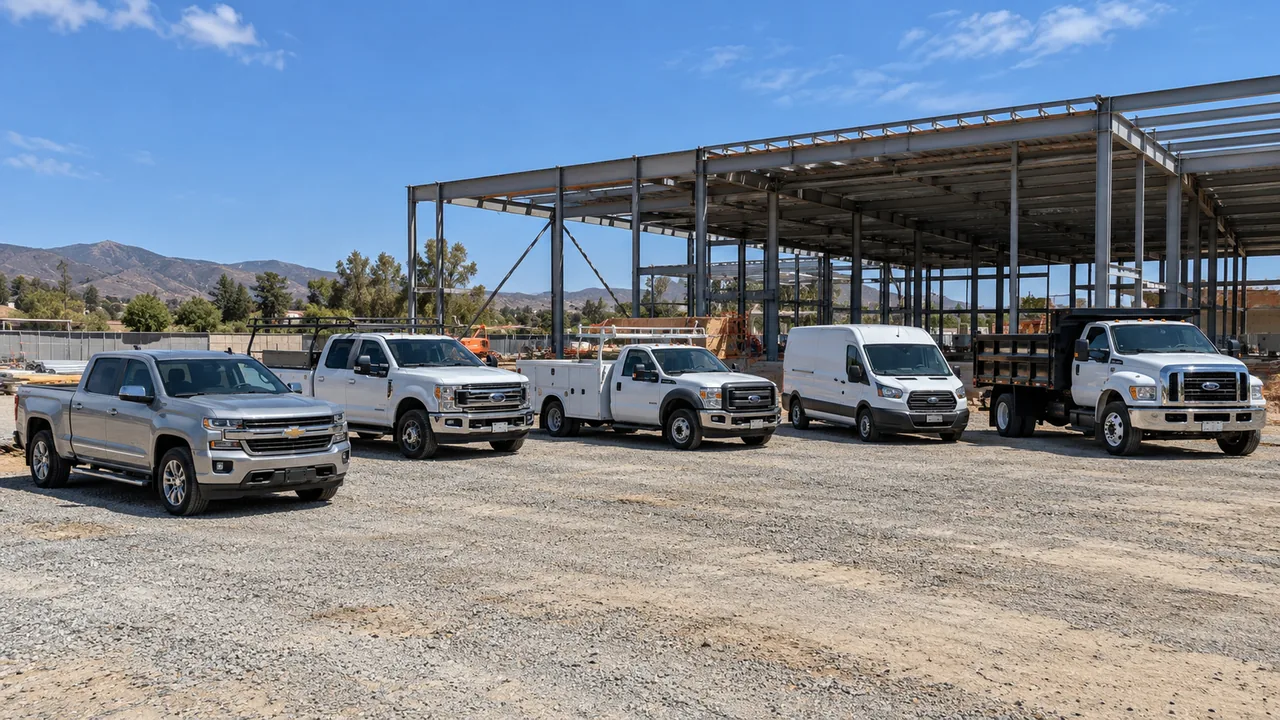
Half-ton to one-ton pickups that carry crews, pull trailers and double as the owner's daily driver, insured on a business policy that says plainly who drives them and what they tow.
Quick answer
A pickup owned by your business, or used mostly for work, usually belongs on a commercial auto policy. Underwriters tend to focus on two things: how much personal use the truck sees and what it tows. Work pickups are rated up to about 14,000 lbs and on their own stay under the CDL line, though a trailer rated over 10,000 lbs behind one can call for a Class A license.
Commercial Auto + Fleet Insurance
CaliforniaUp to 50 VehiclesWe’re here to help.
Work pickups are the light trucks of most fleets, from half-tons rated around 6,000 to 7,500 lbs, through three-quarter-tons in Class 2b, to one-ton duallies rated up to roughly 14,000 lbs in Class 3. The cab-and-chassis versions of those one-tons carry flatbeds and service bodies and have their own pages; this one is about pickups with a factory bed.
On its own, a pickup stays well short of the 26,001-lb CDL line. Towing is usually what brings it closer. A one-ton dually pulling a loaded gooseneck can form a combination rated well past 26,000 lbs, and with a trailer rated above 10,000 lbs by itself, that pairing generally calls for a Class A. That rule catches a lot of pickup owners by surprise.
Each body type on our hub for commercial truck insurance in California typically starts from the same policy; pickups are simply where many fleets start. Heavy towing combinations can also raise permit questions, which the MCP 65 permit guide explains.
A pickup is the work vehicle that most resembles a personal one, and that shapes how underwriters approach it. The truck that hauls a compressor to a job on Tuesday may take the kids to practice on Saturday. Most carriers aren't against that; they want it disclosed and governed. Who else drives the truck? Does it go home every night? Is it the owner's only vehicle? Is anyone under 25 allowed behind the wheel?
Those answers matter because personal use can carry personal exposures onto a commercial policy: a newly licensed driver in the household, a night out, a long holiday drive to the lake. A business that writes down who may drive each pickup, and whether relatives may, gives the underwriter something firm to rate instead of a guess.
Towing is the second line of questions: which trailers, how heavy, how often and whether the hitch and brakes are rated for the load. A pickup pulling more than its hitch is rated for is the kind of detail that can turn into a problem when a claim is investigated.
Owners sometimes assume a pickup needs less liability than a heavy truck. A crash involving a pickup and a loaded trailer at freeway speed can injure as many people as a box truck crash, which is why our pickup quotes still begin at a $1 million combined single limit. Where contracts allow, a pickup can be written at $300,000, $500,000 or $750,000, with one catch: A pickup rated over 10,000 lbs, or one towing a trailer rated over 10,000 lbs, generally needs a Motor Carrier Permit, which sets a $750,000 floor.
For physical damage, the factory truck is fairly easy to value; the additions are harder. Crossbed toolboxes, ladder racks, bed covers, work lights, lift kits and aftermarket wheels should all be listed. The choices behind deductibles and settlement are laid out on the page covering comprehensive and collision for work trucks.
Pickups are a favorite of thieves: The CHP's 2025 figures name older Silverados the most-stolen personal truck in California for the fourth year in a row. Comprehensive is typically what responds when a work pickup disappears. And when employees drive their own pickups to jobs, hired and non-owned auto insurance can protect the business, since their personal policies may not respond to business use.
Official sources
Nearly every trade we write keeps at least one pickup, and most run several. Here's how each one tends to use them.
Superintendents' trucks moving between sites, often towing.
General contractor commercial auto insuranceCrew trucks with lumber racks and a tool trailer behind.
Framing contractor commercial auto insuranceForemen's and estimators' trucks between stake-bed runs.
Drywall contractor commercial auto insuranceLadder-rack pickups for smaller crews.
Painting contractor commercial auto insuranceCrew trucks pulling dump trailers between tear-offs.
Roofing contractor commercial auto insurancePickups for larger installs and long wire runs.
Alarm installer commercial auto insuranceBed-mounted tanks and boxes for treatment products.
Pest control commercial auto insuranceLight field-repair trucks with a welder or compressor in back.
Equipment repair commercial auto insuranceSurvey and inspection trucks on long field days.
Engineering firm commercial auto insuranceThe truck that pulls the mower trailer every morning.
Landscaping truck and trailer insuranceAugers and fence materials, usually with a trailer.
Fence contractor commercial auto insuranceRoute trucks carrying chemicals to weekly service stops.
Pool contractor commercial auto insuranceForemen's trucks and the pickup that tows compact equipment.
Grading contractor truck insuranceCrew trucks pulling tack and crack-seal trailers.
Paving contractor truck insuranceLocating and support pickups that follow the drill.
Directional boring contractor truck insuranceSmall keg runs to nearby bars and restaurants.
Brewery delivery van insurancePickup rates usually swing more on the people and the use than on the truck. These are the factors we see doing the work.
| Factor | How it shows up on a pickup |
|---|---|
| Personal use and household drivers | A truck that doubles as the family vehicle brings more drivers and more miles, so carriers commonly ask who else drives it. |
| Driver age | A pickup is often a young employee's first company vehicle, and drivers under 25 can move the rate more than the model does. |
| Towing | Regular towing of heavy equipment trailers adds exposure, and each trailer typically needs its own line on the schedule. |
| Weight class | A one-ton dually usually rates differently from a half-ton, mostly because of what it's built to pull and carry. |
| Garaging | Pickups taken home are generally rated at the employee's ZIP, and theft and claim patterns can vary a lot across California. |
| Additions | Racks, toolboxes and lift kits raise the scheduled value and the cost of repairs. |
| Mileage and radius | Survey trucks can log long daily miles, while a contractor's pickup that stays in one county logs far fewer. |
GPS and telematics show when and where a pickup is driven, which is often the clearest answer to the personal-use question. How carriers may use that data is covered in how dashcams and telematics can help protect a fleet.
Check three ratings before a pickup pulls anything heavy: the truck's towing capacity, the hitch's rating and the combined weight rating on the door sticker. Trailers with their own brakes generally need a working controller in the truck, and safety chains and breakaway cables should be in use every time.
For insurance, liability for a crash usually follows the pickup doing the towing, but physical damage for the trailer generally responds only when the trailer is on the schedule. The equipment trailer insurance page covers utility, dump and gooseneck trailers in detail.
The owner's own pickup is often the hardest vehicle on the account to classify. It may be titled to the business or to the owner, used for bids and job walks during the week and family trips on weekends. Put it where it belongs, on the business policy if the business owns it or uses it mostly for work, and list every household driver.
Managers given a company pickup as part of their pay raise the same questions. A policy written with "any auto" liability can help cover gaps; our comparison of scheduled autos vs any auto coverage explains the difference, and fleet insurance for 5 to 10 vehicles covers what changes once a handful of pickups share one policy.
Crew-cab pickups move workers between sites every day. Employees hurt as passengers in a company truck are usually a workers' comp matter rather than an auto one, while other people in the truck, or in the car you hit, generally fall under the auto policy. Riding in the bed is restricted under California law and is a red flag to most underwriters, so keep crews in seats with belts on.
Usually not. An employee hurt riding in a California company pickup goes to workers' comp, while passengers who aren't employees and people in the other car generally fall under the auto policy.
Pulling a trailer heavier than the hitch, the truck or the combined rating allows is the kind of detail that tends to surface when a crash is investigated. Check all three ratings before a pickup tows anything heavy.
The owner's pickup often sits on a personal policy while it handles bids and job walks all week. If the business owns it or uses it mostly for work, move it over and list every household driver.
By the CHP's 2025 count, older Silverados were again California's most-stolen personal truck, a fourth straight year at the top. Comprehensive is typically what pays when a work pickup vanishes, so it's worth weighing even on an older truck.
Timing depends on the carriers and your loss history.
Have ready: vehicle list with VINs, driver list, current declarations page, loss runs.
Next Level Experience. Insurance Done Right.
Fleet quotes for California businesses running up to 50 trucks and vans.