FlatbedGVWR
- Weight
- 10,001–33,000 lbs typical
- CDL
- Over 26,000 only
- Trades
- Framers, drywall, fence, roofing

Commercial auto for drywall contractors: stake beds that carry board, boom trucks that set it through upper-floor openings, crew pickups for hangers and vans for tapers. One truck or up to 50 vehicles.
Quick answer
A drywall contractor typically puts its stake beds, boom trucks, crew pickups and taper vans on one commercial auto policy, with each driver listed and the boom's value on the schedule. Most subcontracts ask for a $1 million combined single limit. Boom trucks rated 26,001 lbs or more generally call for Class B drivers, and texture overspray is usually a general liability question, not auto.
Commercial Auto + Fleet Insurance
CaliforniaUp to 50 VehiclesWe’re here to help.
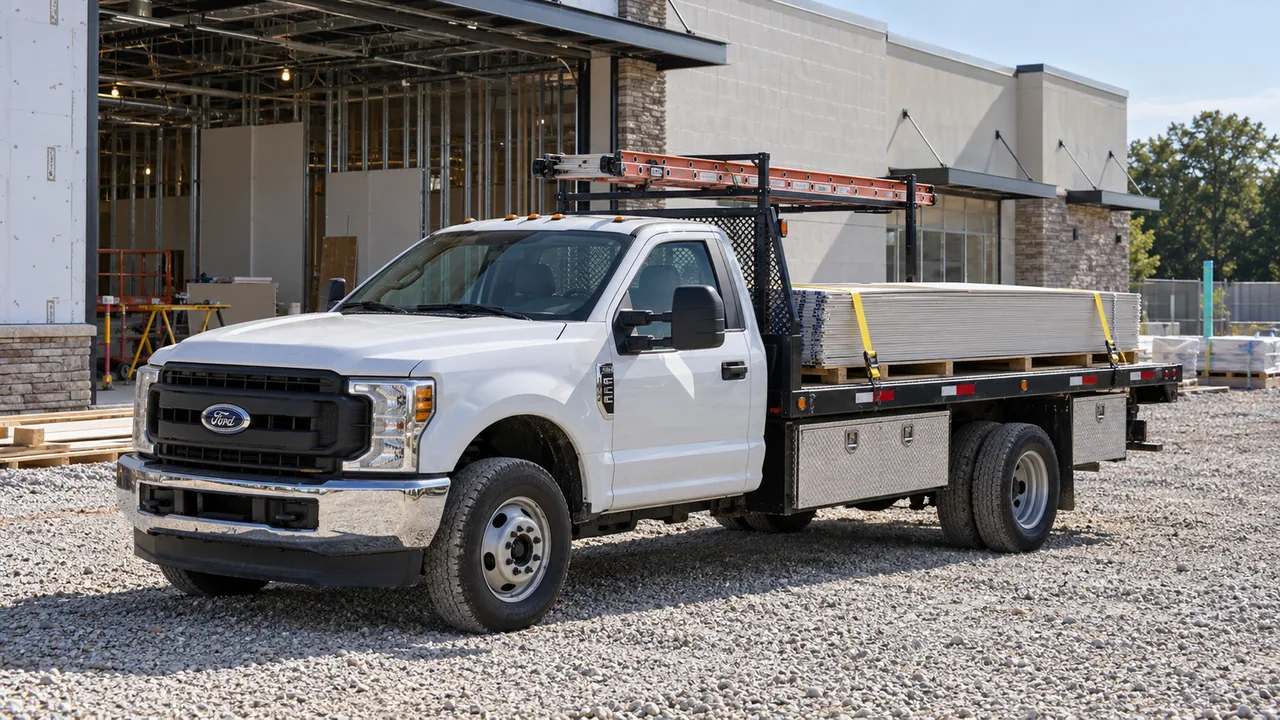
Board is heavy, awkward and easy to damage, so a drywall contractor's trucks are built around moving it. The workhorse is a stake bed, often a medium-duty chassis with a long deck, loaded at the supply yard or from a partial delivery and driven to the job. Some contractors put a boom loader on the stake bed, a truck-mounted boom that lifts stacks of board off the deck and sets them through a second- or third-floor window opening. Others carry board in by hand, which means a crew rides along in a crew-cab pickup.
Hangers and tapers drive differently. Hanging crews move with the board, a few large jobs at a time. Tapers and finishers work alone or in pairs out of cargo vans full of mud buckets, banjos, boxes, stilts and sanders, and they may visit several jobs in a day. Texture crews add a trailer or a truck-mounted rig with a pump and compressor. One state license spans all of it: CSLB's C-9 Drywall classification covers hanging gypsum board and the nonstructural metal framing behind it, plus the taping and texturing that finish the surface.
Weight is the detail to watch. A stake bed loaded with board reaches its rated weight quickly, and a boom adds weight before any board goes on. Many boom-equipped trucks are rated at 26,001 lbs GVWR or more, which generally means the driver needs a Class B license. Plain stake beds and taper vans usually sit below that line. Stake bed and flatbed truck coverage explains how carriers rate those bodies.
Official sources
Liability is the anchor. A heavy stake bed that can't stop in time at a yellow light, a boom truck that clips a parked car while maneuvering into a tight cul-de-sac, a taper's van that rolls a stop sign between jobs: Each would typically land on your auto policy. General contractors and builders typically ask drywall subs for a $1 million combined single limit. How auto liability limits work covers the details.
Unloading is where drywall gets interesting. Most business auto forms treat loading and unloading with a device attached to the truck, like a mounted boom, as part of using the auto, so a bundle that drops onto a car parked below or swings into a neighbor's fence can be an auto claim. A separate forklift or a rented crane doing the same lift usually isn't. Wording varies by carrier, so we read your auto and general liability policies side by side for where a boom accident would likely land.
Physical damage should reflect the whole truck. A boom adds a large share of value to a stake bed, and a policy that lists only the chassis value can leave you short after a total loss. Read about physical damage on boom and stake bed trucks.
Most GC and builder subcontracts for wall and ceiling work name a $1 million combined single limit, so that's where a drywall quote begins. Residential remodel drywallers who work for smaller contractors may be allowed $500,000 or $750,000, and $300,000 is an option where nobody downstream requires more. Commercial interiors contracts often add additional insured status for the GC and owner, a waiver of subrogation and primary wording. Read those clauses before you price the job, since a contract that requires more than your policy carries usually means an endorsement first.
Boom trucks bring the filing questions. A truck heavy enough to need a Class B driver may also need a Motor Carrier Permit, depending on how it's used; our MCP 65 guide explains the test and the filing the carrier submits to the DMV. If you're adding a used boom truck, send its GVWR and body details before you buy so we can check which carriers may write it.
Drivers count here, too. Carriers that write trucks in the commercial license class usually want those drivers to have real experience in that class, and a contractor with one boom operator should have a second qualified driver named for days off and vacations.
A drywall contractor who keeps a short checklist for boom setups, pulls MVRs every year and puts cameras on the stake beds is usually easier to price. The fleet safety controls that hold up in a claim explains what each one can do.
Expect a follow-up question about who rides with the board. It's normal for hangers to sit in a crew cab while a full load rides on the deck behind them, but an underwriter will likely want to know the load is strapped before the crew climbs in and that nobody rides on the deck itself.
A one-truck drywall business is usually a stake bed or a long-bed pickup and a small hang crew, with the owner driving. It's generally rated like a small business auto account, mostly on the owner's record and where the truck is garaged. If you rent a boom truck for the occasional multistory job, ask us first; rented trucks usually fall under hired auto coverage, and the rental agreement may push the damage back onto you.
At five to ten units, the schedule mixes stake beds, a boom truck or two, crew pickups and a couple of taper vans. Carriers often look at the boom drivers separately from the van drivers, and a single serious claim on a boom truck can move the whole account's price. Fleet insurance for growing contractors explains what changes as the count passes ten.
Wall and ceiling contractors with eleven to fifty units usually run commercial interiors and multifamily work from a yard, with dispatch, several boom trucks and a dozen or more vans. Underwriters tend to weigh the written safety program, driver qualification files and the loss trend more than any single truck. Contractors this size often shuttle board from their own yard to jobs, so the stake beds put on real miles even when every job is local. Add each new boom truck or stake bed by endorsement before it carries board.
Setting board through an upper-floor opening is fast and saves backs, but it puts a lot of risk into a few minutes. The truck is often parked on a street or a half-finished driveway, outriggers down, with the boom reaching over a sidewalk. Overhead power lines, a car parked too close, a pedestrian who walks under the load, a new curb that cracks under an outrigger: Those are the moments underwriters ask about.
The practices that help are not complicated. Survey the drop zone before the truck arrives. Keep a spotter on the street side. Put outriggers on pads, not bare concrete or soft fill. Look up for lines before the boom goes up; Cal/OSHA's overhead-line rule generally bars operating boom-type lifting equipment inside set clearances from energized high-voltage lines, so that glance has a regulation behind it. Let only trained operators run the controls, and keep a log of who did. On a multifamily job, coordinate the drop with the GC so the street side is coned off and other trades aren't parked under the swing.
When something does go wrong, whether the auto or general liability policy answers depends on wording and on what was happening at the time. We look at both before you buy the next boom truck, so a gap is more likely to turn up in a quote than in a denial letter. Commercial truck insurance in California covers the heavier units in more depth.
Official sources
Often, when the boom is mounted on the truck and the board is being unloaded. The policy wording decides, so we compare your auto and general liability forms.
A boom truck rated at 26,001 lbs or more generally needs a Class B driver. Letting someone without one take it out can turn a routine claim into a coverage dispute.
Hangers follow the board to a few jobs; tapers bounce between several a day in vans. Their mileage and records can matter as much as the boom truck's weight.
An outrigger set on a fresh driveway or curb can crack it. Pads and a quick look at the surface before setup can head off a property damage claim that never needed to happen.
Delivery box trucks and installer vans.
Commercial auto for cabinet makersThe last trade in, with loaded cargo vans.
Commercial auto for flooring installersPainters and their vans, right after the tapers.
Commercial auto for painting contractorsBuilders who set the certificate requirements.
Commercial auto for general contractorsTiming depends on the carriers and your loss history.
Have ready: vehicle list with VINs, driver list, current declarations page, loss runs.
Next Level Experience. Insurance Done Right.
Fleet quotes for California businesses running up to 50 trucks and vans.