Work pickupGVWR
- Weight
- Up to 14,000 lbs typical
- CDL
- No
- Trades
- Every trade

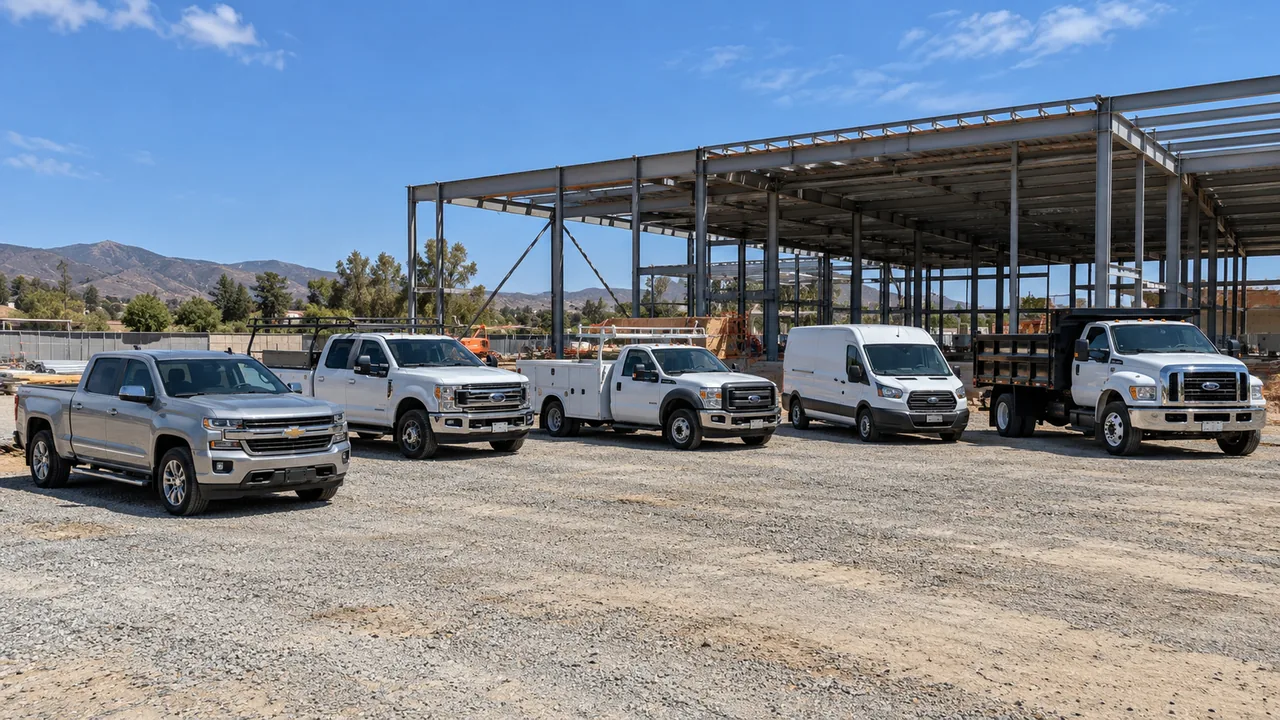
Business auto for residential and commercial builders: the superintendent's pickup, the one-ton with the equipment trailer, the small dump and the flatbed. One truck or a full fleet, quoted with top-rated national carriers.
Quick answer
A general contractor typically carries one commercial auto policy listing each company pickup, dump and trailer, plus hired and non-owned coverage for supers and project managers who drive their own cars to sites. We start at the $1 million combined single limit most owner contracts name. Subcontractors' trucks generally belong on their own policies, which is why you collect their certificates.
Commercial Auto + Fleet Insurance
CaliforniaUp to 50 VehiclesWe’re here to help.
A general contractor's schedule is rarely one kind of vehicle. Superintendents run half-ton and three-quarter-ton crew cabs with a plan box behind the cab. Field crews run a one-ton pulling a bumper-pull or gooseneck equipment trailer, moving a skid steer, a mini-excavator or a compact track loader from lot to lot. Remodel builders keep a dump trailer or a small single-axle dump for demo debris and transfer-station runs, and many commercial builders add a flatbed for shoring, forms, temporary fence and rental returns.
Residential and commercial work put those trucks in different places. A custom-home builder may park three pickups at one hillside lot for a year, nose to tail on a narrow street beside the neighbors' cars. A tenant-improvement contractor works around occupied buildings, unloading in alleys and backing into parking structures with low beams. A ground-up commercial GC keeps trucks behind a fenced laydown yard but sends them onto busy arterials every day for deliveries, inspections and supply runs.
Most carriers want each power unit listed with its year, VIN, value and overnight location, and each trailer on its own line with its own value. A dump body in the mix usually draws more questions than the pickups do; our dump truck insurance page explains why. Most GC pickups and one-ton dumps are rated well under 26,001 lbs GVWR, so a commercial license rarely comes up until a heavier truck or a big trailer combination joins the fleet.
Liability is where a general contractor's auto exposure concentrates. A loaded equipment trailer that sways into the next lane on a downhill grade, gravel bouncing out of a dump onto a windshield, a superintendent backing into a homeowner's gate: Each one can become a claim by someone else against the company named on the policy. We build the quote around a $1 million combined single limit because owner, developer and lender contracts usually write that number into their insurance requirements. See how carriers structure commercial auto liability for contractors.
Physical damage typically protects your own iron: collision for the one-ton that slides off a muddy haul road, comprehensive for the pickup broken into overnight on an unfenced lot. Trailers are a real theft target. The CHP counted 7,331 trailers stolen in California in 2025, and Bobcat topped its list of stolen construction equipment brands, the same kind of compact loader many GCs leave chained to a trailer overnight.
Hired and non-owned coverage often matters more to a GC than to most trades. Project managers drive personal cars to site walks, estimators drive to pre-bid meetings, and a rental truck fills in when a pickup is in the shop. Hired and non-owned auto coverage is designed to protect the company on those trips.
Official sources
A GC account usually opens at a $1 million combined single limit. A small residential builder whose clients and lenders don't require that much can step down to $750,000, $500,000 or $300,000, but read the contract first. Public agencies, commercial owners and most construction lenders typically put the auto limit in writing, and a certificate that comes up short can stall a progress payment or a notice to proceed.
Commercial contracts rarely stop at a number. The owner, architect or property manager will often want language saying your coverage is primary and noncontributory, additional insured status on your auto policy and a waiver of subrogation. Each of those is usually handled by endorsement. Some carriers attach them on a blanket basis for anyone you've agreed in writing to cover; others want each name scheduled. Send us the insurance exhibit while you're still bidding so there's time to request the endorsements it calls for before the job starts. When an owner wants more auto protection than $1 million, the extra is usually met with an umbrella or excess policy sitting above the auto, rather than a bigger auto limit.
Filings come up less for GCs than for haulers, but a heavy dump or a large flatbed can change that. Our Motor Carrier Permit guide explains when the permit generally applies and how the carrier makes the MC 65 M filing for you.
A GC who reviews MVRs at hire and every year after, runs cameras on the trucks that tow and keeps a clean certificate log for subs gives the underwriter something concrete to credit. Our fleet safety and claims defense guide explains what each of those controls can do once a loss is reported.
If a past claim involved a trailer coming loose or debris leaving a dump, say what changed afterward: new safety chains, a tarp rule, a hitch check every Monday morning. A clear answer to the follow-up question often matters as much as the claim itself.
A builder with one pickup and a dump trailer is usually rated like a small business auto account, and the owner's driving record does most of the talking. Single trucks are welcome here; business auto for one to four vehicles covers how carriers rate them. If the dump trailer is the heaviest thing you tow, say so up front; it helps keep the account in front of carriers that write small builders rather than haulers.
Between five and ten units, the account starts to read as a fleet. Each super has a truck, there are two or three trailers, and maybe a dump. The carrier will often want a written rule on who may drive which unit, especially the trailers and the dump, because that's where the severe claims tend to come from.
From eleven to fifty, trucks are usually assigned to projects rather than to people, and they move between divisions as jobs open and close. Underwriters tend to look closely at the loss trend year by year, at how quickly a new hire gets the keys and at whether driver files follow the truck when it changes jobs. Add a truck by endorsement before it reaches a site, and when a job wraps and a pickup is sold, tell us so it comes off the schedule instead of riding along until renewal.
A general contractor sits in the middle of the certificate chain. Owners, developers and property managers usually want proof of your auto coverage before you mobilize, and you ask each subcontractor for the same proof before they set foot on site. That second half helps protect your own policy. When a framer's flatbed or an electrician's van causes a crash on the way into your job, the injured driver often names the GC as well, and the sub's auto policy is the one that ought to answer.
A quick review of each sub's certificate covers four points: the auto limit meets your subcontract; the policy covers owned, hired and non-owned autos; the dates run through the end of the job; and any additional insured wording you required appears as an endorsement rather than a remark typed on the certificate. A certificate is typically informational only and doesn't amend the policy, so ask for the endorsement page when the contract calls for one.
Underwriters who see a disciplined certificate process tend to read the whole account as well run. When subs ask what their own auto should look like, point them to our pages for framing crews, drywall contractors and the rest of the commercial auto trades we write.
Usually not. A subcontractor's truck should be on the sub's own auto policy, which is why your subcontract asks for their certificate. Your policy can still be pulled into the claim, so keep that certificate on file.
A gooseneck or dump trailer left off the vehicle list may have no physical damage coverage after a theft or rollover. Give every trailer its own line and value.
Commercial owners often tuck auto requirements into the contract's insurance exhibit. Catching an additional insured or primary wording request early is far easier than fixing it while a payment is held.
Adding a single dump to a schedule of pickups can change which carriers will quote and how they rate everything else. Ask us before you buy the truck.
Board on stake beds, set by boom or carried by crews.
Commercial auto for drywall contractorsBox trucks bringing finished boxes to your jobs.
Commercial auto for cabinet makersHigh-roof vans full of plank, tile and saws.
Commercial auto for flooring installersVans and pickups loaded with ladders and sprayers.
Commercial auto for painting contractorsTiming depends on the carriers and your loss history.
Have ready: vehicle list with VINs, driver list, current declarations page, loss runs.
Next Level Experience. Insurance Done Right.
Fleet quotes for California businesses running up to 50 trucks and vans.