Cargo vanGVWR
- Weight
- Up to 10,000 lbs typical
- CDL
- No
- Trades
- HVAC, alarm, painting, flooring

Commercial auto for heating and air companies running service vans and utility-body trucks, from one van to fifty. Set your van count to start a quote with top-rated national carriers.
Quick answer
Most California HVAC companies need one commercial auto policy listing each service van and truck, hired and non-owned coverage for employees' own cars and coverage for technicians who take vans home. HVAC quotes from us begin with a $1 million combined single limit.
Commercial Auto + Fleet Insurance
CaliforniaUp to 50 VehiclesWe’re here to help.
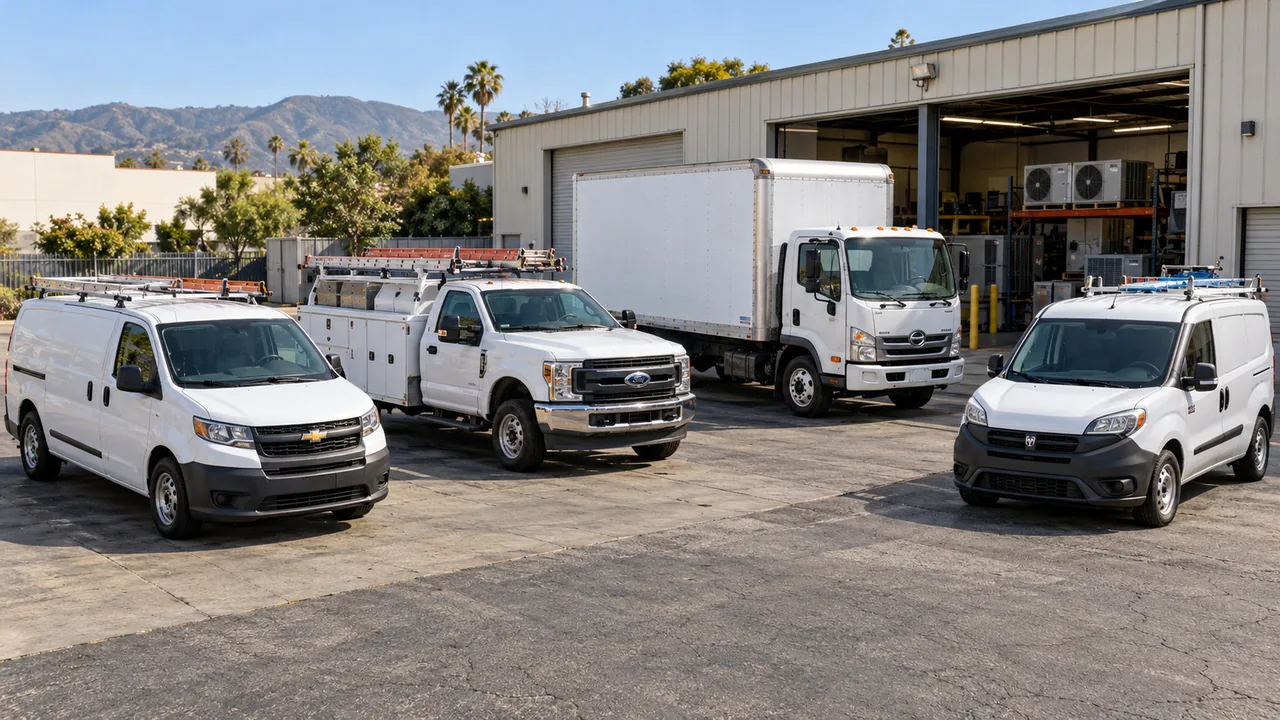
Most heating and air fleets are built on cargo vans (Transit, ProMaster, Sprinter, Express) and service-body trucks on 1-ton and medium-duty chassis. Install crews add a pickup or two, and larger shops keep a box truck or flatbed for moving condensers, air handlers and duct to a job.
Almost all of it is two-axle and rated under 26,001 lbs, so a regular Class C license generally covers the drivers unless a van tows a trailer rated over 10,000 lbs. That's good for hiring, and it can widen the carrier market, but most underwriters still want each unit listed with its year, value and the ZIP where it parks overnight. For most HVAC shops, that ZIP is the technician's home, because the vans go home with the techs.
Take-home vans are the single biggest rating question we see from HVAC owners. A van garaged in a technician's driveway in a dense part of the Inland Empire can rate differently from the same van parked behind a locked shop gate. Many carriers also ask whether techs may use vans for personal errands and whether family members ever drive them. Clear, written answers to both can make the account easier to quote.
Official sources
Liability is the core: A technician running late to an emergency no-cool call in July is just the kind of driver who can rear-end someone at a light. The $1 million combined single limit we start from is the figure property managers, general contractors and commercial service agreements commonly require on the certificate.
Physical damage is usually worth carrying on newer vans and anything financed. A fully upfitted service van can be worth far more than the base vehicle once shelving, a ladder rack and an inverter are added, so list the upfit value when you schedule it. Read more on physical damage coverage for trucks.
Hired and non-owned typically covers the company when a dispatcher runs to the supply house in a personal car, or a tech's van is in the shop and a rental fills in. See coverage for employees' own cars on company business.
Our default for HVAC accounts is a $1 million combined single limit. Where your contracts allow, lower limits of $300,000, $500,000 and $750,000 can be quoted. A commercial maintenance contract with a hospital, school district or large property manager may also ask to be named as an additional insured on your auto policy, an endorsement we request from the carrier subject to its approval. The same contracts usually ask for your contractor's license as well, which for heating and air work is generally CSLB's C-20 classification.
Most HVAC vans are rated 10,000 lbs or less, which generally keeps them outside California's Motor Carrier Permit. A heavier two-axle truck may not be. The MCP 65 (MC 65 M) insurance filing explains the line and the MC 65 M filing.
Official sources
Shops that can show a short written vehicle policy, annual MVR checks and in-cab cameras tend to give the underwriter reasons to credit the account. Our fleet safety measures underwriters often credit page covers what each of those can do when a claim comes in.
Install days put a different kind of load on the road. A 4-ton condenser, an air handler and a pallet of flex duct ride in a box truck with a liftgate, on a flatbed or in a trailer behind a crew pickup, and the risk tends to shift from the technician's daily driving to securing and unloading heavy, awkward equipment at a job site.
Underwriters often ask who drives the install truck, whether loads are strapped or palletized and whether the liftgate is used by trained staff. A unit that shifts at a stop can damage the truck and anything around it. The truck's damage typically falls to auto; the condenser itself, before it's installed, usually belongs on your equipment or installation coverage.
If you rent a box truck for install season rather than owning one, tell us. A rented truck is usually covered differently from a scheduled one, and box truck insurance quote explains what changes when a box truck joins the fleet permanently.
Heat waves in July and cold snaps in January stretch an HVAC shop past its regular fleet. The usual fixes are a rented van for a few weeks, a seasonal technician or a sales rep using a personal car to run estimates. Each one touches the auto policy in a different place.
Shops that plan the surge before it arrives (a short list of approved rental agencies, a driver add form and a standing rule on personal cars) make it less likely that an August claim lands on a vehicle or driver the policy doesn't list. Compare the two approaches in when to list an employee's vehicle.
One van is usually quoted like any small business auto account. At five to ten vans, most carriers start treating the shop as a fleet: one policy, one renewal date and driver standards they can rate. Past 25, the safety program and your loss-run trend tend to set most of the price, and a broker's job is to present that history well.
Growing mid-season? New vans are typically added by endorsement and priced for the rest of the term. Tell us before the van goes into service, not after, so the carrier can add it before its first call.
Often, yes. The van is usually rated where it sleeps, and a technician's home ZIP may carry more theft and claims than your shop's.
A van scheduled at its base value can leave the shelving, ladder rack and equipment mounts out of a total-loss settlement. List the upfit with the van.
Summer emergency calls put more techs on the road for longer. Carriers often notice claim spikes in July and August on HVAC loss runs.
A forward camera can show what happened at the light. That evidence matters most when the other driver's story changes later.
Service trucks and jetter rigs that also go home with techs.
Commercial auto for plumbingLight vans with ladder racks, mostly in town.
Commercial auto for alarm and securityPickups carrying products, with their own rules.
Commercial auto for pest controlCrane-body trucks and customers' equipment.
Commercial auto for equipment repairTiming depends on the carriers and your loss history.
Have ready: vehicle list with VINs, driver list, current declarations page, loss runs.
Next Level Experience. Insurance Done Right.
Fleet quotes for California businesses running up to 50 trucks and vans.